


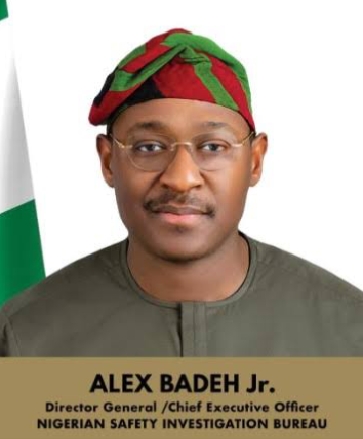

The Nigerian Safety Investigation Bureau ( NSIB) has announced a significant stride in its mandate to investigate maritime accidents, stating that it has received approval to join the Nigerian Navy’s Falcon Eye surveillance system.
The collaboration with the Navy aims to provide timely notifications of accidents on Nigeria’s coastal waters, a critical step toward improving maritime safety.
The Director General of NSIB, Captain Alex Badeh Jr. disclosed this during a virtual interactiion with some select journalists on Wednesday evening.
He said, “We just got approval to join the Falcon Eye of the Nigerian Navy as they survey our coastal areas so we can be notified of accidents on our coastal waters.
“So, you know, it’s one step forward, we have a seat at the table there, and from September, we’ll be fully in there, we’ll have personnel attached to the Navy, so we will be notified of these things moving forward.”
Lamenting that bureaucratic hurdles currently impede safety in the maritime sector, the NSIB DG seeks full cooperation from the Nigerian Maritime Administration and Safety Agency (NIMASA) to fulfill its mandate, which he said is crucial for aligning Nigeria with the policy requirements of the International Maritime Organisation (IMO).
“Bureaucracy gets in the way of safety when it comes to the maritime industry right now and which is why we’re trying to talk to NIMASA. Yes, there is a bit of communication gap between the NSIB and NIMASA, but we are working to remedy that. We’re working for the Federal Republic of Nigeria and the taxpayers so we should come together and work together,” he said.
Addressing concerns about a potential overlap of functions with NIMASA, which is recognized by the IMO to handle maritime accident investigations, Captain Badeh explained that NIMASA was designated as the sole authority because there was a vacuum before the NSIB was established.
He maintained that the emergence of NSIB had closed the gap, noting that the IMO prefers an independent investigative body, a global best practice also seen in the aviation sector where the NSIB’s predecessor, the Accident Investigation Bureau (AIB), operated independently of the Nigerian Civil Aviation Authority (NCAA).
His words, “There was no NSIB when all this happened. But even the IMO preferred to have an independent body. Best practices all around the world usually has an independent investigation body outside of whoever the regulator is.
“So, NMASA were the sole body recognized, prior to now, they were the only ones doing that. But of course, with our Act and the passing of the NSIB Amendment Act in 2022, that gave birth to NSIB.
“We have worked with the IMO to develop the Maritime Safety Investigation Regulations. We are recognized by the IMO. And once this is finalized, there will be more documentation and information to reflect the status of the NSIB as the sole accident investigative body for maritime accidents in Nigeria. ”
Badeh said the NSIB have already met with the Nigerian Railway Corporation (NRC), the National Inland Waterways Authority (NIWA) and the Nigerian Navy and they have all agreed to partner with the Bureau towards an independent investigation operations in the rail, maritime and inland waterways sectors.
He added that the Bureau is in the process of hiring new personnel
for effective investigation of occurrence across all modes of transportation, assuring that some professionals would come onboard by September this year to
to build its team of investigators.
On the issue of funding, the DG acknowledged ongoing engagements with NIMASA and the National Assembly to resolve funding challenge especially given the Bureau’s expanded scope of operations.
He mentioned that the NSIB does not draw funds from NIWA and is exploring alternative funding options with the federal government.
“Typically, all around the world, most accident investigative agency, do not go for cost recovery from the regulators, it’s usually a standing budget There should be no question about that because we are to prevent accident and when they do happen, which is very likely , we should be able to come out with all causes to prevent reoccurrence.
So, I will be looking to go back to the government as well to ask them for more funding. We’re in the process right now, ” he said.
Responding to a question about the 12-month timeline for publishing an interim report on maritime accidents, Badeh explained that the policy aligns with the IMO’s Casualty Investigation Code and the UN Convention on the Law of the Sea.
He clarified that the NSIB’s role is not to apportion blame but to determine the causes of an accident to prevent future occurrences.
“Our roles in these sectors will be mainly independent investigation. We won’t be involved in sanctions on errant operators after the investigation exercises. Once we conclude the investigation on any incident in these sectors, we will hand over our report to the regulatory agencies mandated by international regulations to sanction, for them to handle the punitive aspect of our findings.” he said.
On railway regulation, the NSIB DG explained that the agency already has an understanding with the Nigerian Railway Corporation (NRC) and will be meeting with the Lagos State government on a partnership concerning existing rail services like the Red Line and Blue Line, including future rail operations under the State government.
“In aviation, what we will be doing is just an upgrade to what we are currently doing. For the maritime and railway sectors, our workers will undergo training to learn the fundamentals of their expanded responsibilities, ” he said.
More to read
Omi Eko: Management clarifies project implementation process
Customs intercepts N3.67bn cannabis-infused cookies, gummies from Canada at Tin Can port
Navy uncovers 40,000 litres of suspected crude oil in Delta