



Maritime industry stakeholders have decried the incessant interference and placement of detention orders on duly cleared cargoes at the nation’s ports by maritime police.
The undue interference, the stakeholders say is causing delays, increase in demurrage/storage charges for consignees and thereby escalating the cost of doing business at the ports.
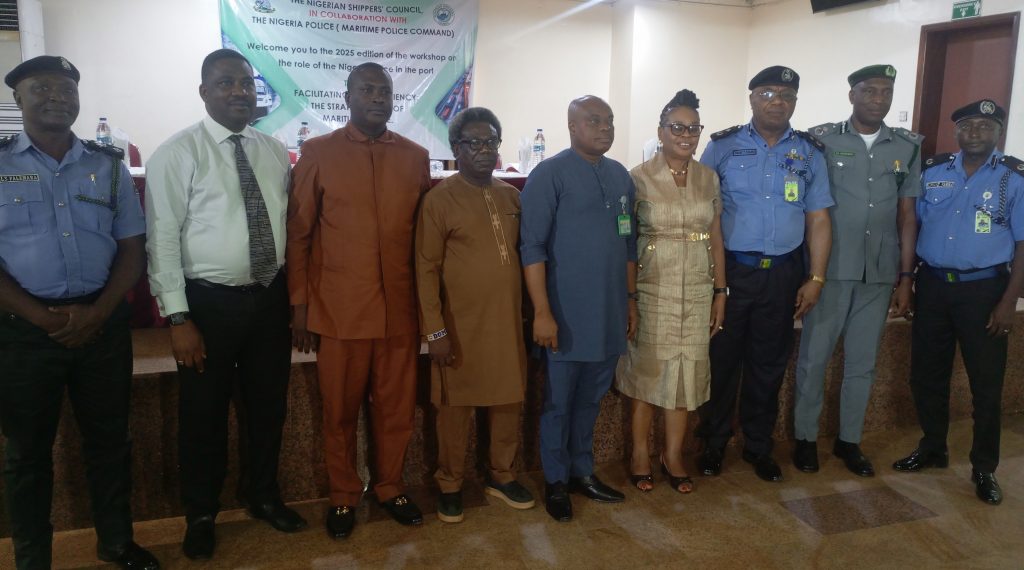
The concerns were raised at a training workshop themed “Facilitating Port Efficiency: The Strategic Role of Maritime Police,” organized by the Nigerian Shippers’ Council (NSC) in collaboration with the Nigerian Police, Maritime Police Command.

In his opening remarks, Executive Secretary of the NSC, Dr. Pius Akutah lamented that the incessant detention order by police often disrupts cargo dwell time, causes delays, and negatively impacts the overall cost of operations.
Represented by the Director of Regulatory Services Department, Mrs. Margaret Ogbonnah, Akutah said while it’s takes only six hours to clear containerized cargo at port of Singapore, and seven days in Lome ports, it’s takes an average of 21 days or more to clear cargo at the nation’s ports.
“The Nigerian seaports has constantly been reputed as one of the ports with the longest cargo dwell time in the world. This is so, because, while it takes only 6 hours to clear a containerized cargo in Singapore port, 7 days in Lome port, it takes an average of 21 days or more in Nigerian ports. This (in addition to other factors) consequently, affected the global perception index on Ease of Doing Business (EDB) in Nigerian seaports.
“Several efforts by the Government to reduce cargo dwell-time at our ports have not yielded desired result due to a number of factors, worst of which is the human factor. However, as the Economic Regulator of the Ports, NSC has the responsibility of ensuring that efficiency is established in the ports in order to attract ignorance, ” he said.
Akutah noted that while NSC and police leadership have previously engaged to streamline processes, infractions still occur on claims by maritime police personnel that they are acting on intelligence reports.
He said the purpose of the workshop is to build capacity and enlighten police officers on port operations and their statutory role to curb abuses.
“Pursuant to its regulatory mandate, the NSC has been collaborating with several agencies to ensure the facilitation of trade and ease of movement of cargo outside the ports to avoid congestion.
“However, several reports that were brought to the attention of NSC by stakeholders, pointed to; incessant interference in the cargo clearance processes, placement of detention orders on duly cleared cargoes, thereby barring its exit from the port terminals and intimidation of personnels of Shipping line agencies and terminals. The officers usually claimed they were acting on intelligence reports, ” he said.
Representing Five Star Logistics terminal, Kenneth Nnana revealed that the terminal has received several detention letters from the police blocking about 2,200 containers from exiting the port.
Also speaking, representive of Mediterranean Shipping Company,
Nigeria Limited, Dimeji Gbadebo, also expressed similar concerns, stating that the incessant detention orders from police, which caused containers to be held for days often lead to high demurrage charges borne by consignees.
“For us as shipping lines our equipment is so important to us. And we are more particular about the turn around of this equipment. Even though demurrage charges we add to our revenue, we do not fancy it.
“A situation where an alert will come and containers will be detained for several days, sometimes weeks, is something that is mitigating against the ease of doing business.
“We want the Police authority, to help look into this issue. I can mention relatively several incessant alert letters that we have received from maritime Police. It is enormous.
“I want to appeal to the authority of Maritime Police to see a way through which they can liaise with other security agencies or perhaps even with other agencies at the port, to ensure speedy investigation is done, if there is any need for that and allow the customer to take their container as quickly as possible, ” he said.
Registrar, of the National Association of Government Approved Freight Forwarder (NAGAFF) Academy, Francis Omotosho, in his paper presentation, stressed that police activities in the port must not add to the cost of cargo clearance.
He stated that placing a detention alert on cargoes already released by Customs is “uncalled for.just as he advocated for a strict timeline for investigations:
“If there’s need to flag down any container, attention of customs or shippers council should be called to it.
“You don’t have a right to delay the cargo. If you have an investigation to carry out, nobody says you should not carry out the investigation but you have to do that under 24 hours, ” he told the police officers.
Omotosho recommended that an Admiralty Court be situated inside the port, as is the practice in other parts of the world, to resolve issues quickly.
Responding to the concerns raised, Deputy Commissioner of Police, Chukwuemeka Obasi, who represented the Assistant Inspection General of Police, Chinedu Oko maintained that the police have the right to flag down containers even after customs clearance, based on intelligence reports.
“If containers are examined at the port, they can never be 100 precent correct.
For example, in the course of containers exiting the port another arm of customs unit decides to flag it down because of intelligence that was not available at the time of exit, will you tell them they can’t intercept it if they find offensive goods because it has already been examined at the port?
“Last week, a container was examined and exited the port, we got intelligence that it should be flagged down and when it was re examined, brand new Ak47s were discovered. It is not all intelligence report we can share with the public., ” he said.
He attributed instances of multiple police units blocking cargo to intelligence that was not adequately processed and stressed the need to harmonize intelligence to prevent delays
The police chief assured stakeholders of the maritime police’s commitment to a to ensuring that the ports operate in a secure, transparent, and orderly environment.
“True port efficiency cannot be achieved by one institution alone. It demands synergy between the Maritime Police, port authorities, shippers, freight forwarders, and the private sector. Every stakeholder has a role in ensuring security compliance, timely reporting of threats, and adherence to regulations.
“The Maritime Police must continue to evolve not as an obstruction to trade, but as a strategic enabler of maritime commerce. Through intelligence-driven operations, technology adoption, and cross-agency cooperation, we can transform Nigeria’s ports into hubs of safety, trust, and economic prosperity.
“With continued collaboration, investment in capacity, and institutional discipline, we can achieve a port system that meets international standards and contributes meaningfully to Nigeria’s blue economy vision.
Representative of Controller, Apapa Area Command of the Nigeria Customs Service, Comptroller Emmanuel Oshoba called for more interagency collaboration to resolve the ongoing trade facilitation challenges.
More to read
Omi Eko: Management clarifies project implementation process
Customs intercepts N3.67bn cannabis-infused cookies, gummies from Canada at Tin Can port
Navy uncovers 40,000 litres of suspected crude oil in Delta