


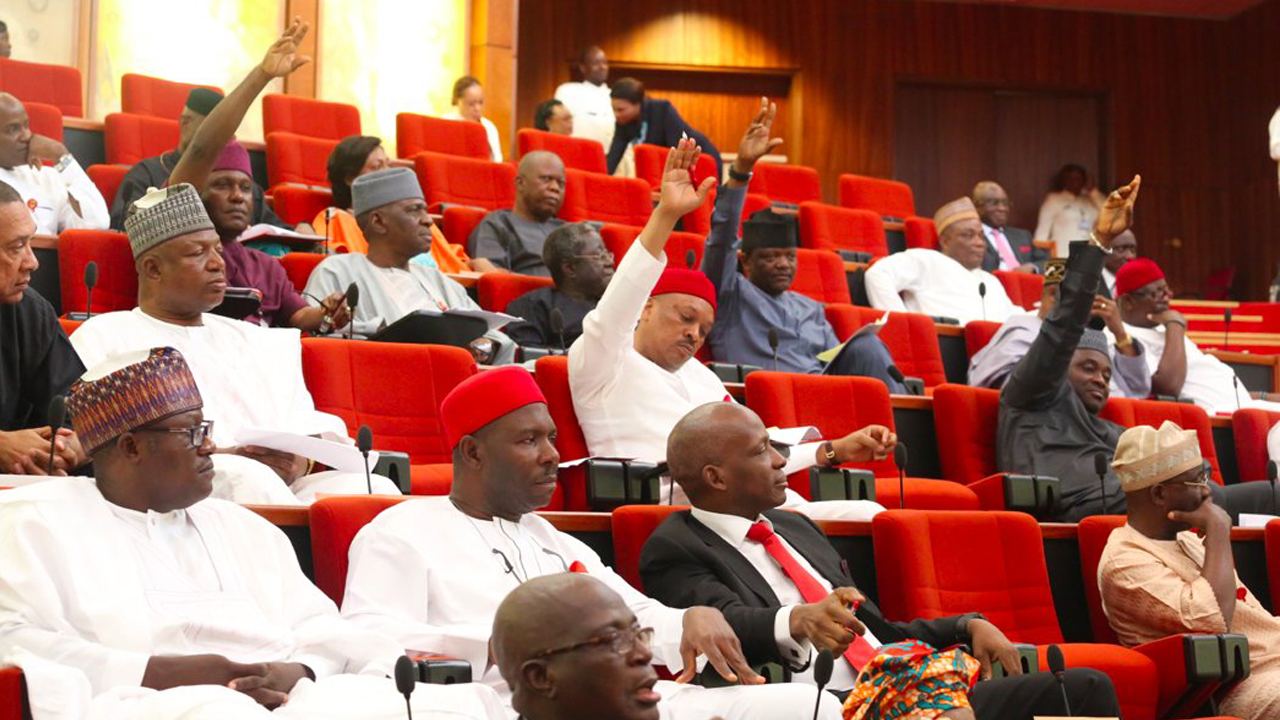

The Senate on Tuesday passed for second reading, a bill that seeks to repeal the Customs and Excise Management Act Cap C45 Laws of the Federation of Nigeria and to enact an Act to establish the Nigeria Customs Service Act 2021 which was enacted 63 years ago.
According to the Senate, it became imperative to carry out the repeal of the Act against the backdrop that in this digital age, trade facilitation is the hallmark of any professional organisation and customs administration, operating under the 1958 colonial laws was not the best interest of the country, especially for a country like Nigeria that is grappling with the serious economic downturn.

The bill is titled, “An Act to Repeal the Customs and Excise Management Act, CAP. C45, Laws of the Federation of Nigeria 2004 and to Enact an Act to Establish the Nigeria Customs Service Act 2021 ( SB.286).
In his lead debate on the general principles of the bill, the sponsor and Chairman, Senate Committee on Customs, Excise and Tariff, Senator Francis Alimikhena, All Progressives Congress, APC, Edo North who noted that the Bill was read the First Time on Wednesday, 29th January 2020, said that “the proposed Bill seeks to bring the Customs and Excise Management Act (CEMA) in line with modern-day reality.
“An analysis of the Customs and Excise Management Act conducted in 2009 found the law to be severely lacking with respect to the World Customs Organization’s Revised Kyoto Convention (RKC). The Customs Excise Management Act (CEMA) as it is today does not contain provisions to support the use of electronic documents, signatures and electronic payment as well as application of Risk management and host of other information technology that are applicable to Modern customs Administration.”
Senator Alimikhena said the bill is aimed at modernizing the Customs Service with a view to making it competitive in the global quest for trade facilitation.
He added that the bill will make the Nigeria Customs Service a legal organization under the supervision of the Ministry of Finance and a Board that will operate in an efficient manner to serve the Nigerian public adding that, “Collection of revenue and trade facilitation will be substantially improved with full implementation of modern Customs procedures which include payments made electronically rather than by cash to reduce the possibility of corruption and increase efficiency in the system.”
“It is important to note that even within the current Nigeria Customs Service legal framework, the executive understood the need for reforms and has proceeded with changes in Customs processes and clearing procedures in a bid to keep up with modern reality. This lends credence for modern custom legislation to cater for current realities. The ideal situation for a transparent Customs system will require that all the enabling laws guiding the operations of the Nigeria Customs Service would be consolidated into a single reference document instead of the Nigeria Customs Service Legal Authority scattered in multiple enactments.
“My appeal, distinguished colleagues is to support the enactment of this Bill so as to empower the Nigeria Customs Service to be at Par with International Standard and to enhance the protection of society against smuggling, illegal weapons, narcotics, counterfeit goods, other trade-related crimes and money laundering,” he said.
The Bill after scaling the second reading was referred to the Senate Committee on Customs, Excise and Tariff by the President of the Senate, Senator Ahmad Lawan who presided over plenary, to report back in four weeks.
More to read
Omi Eko: Management clarifies project implementation process
Customs intercepts N3.67bn cannabis-infused cookies, gummies from Canada at Tin Can port
Navy uncovers 40,000 litres of suspected crude oil in Delta