


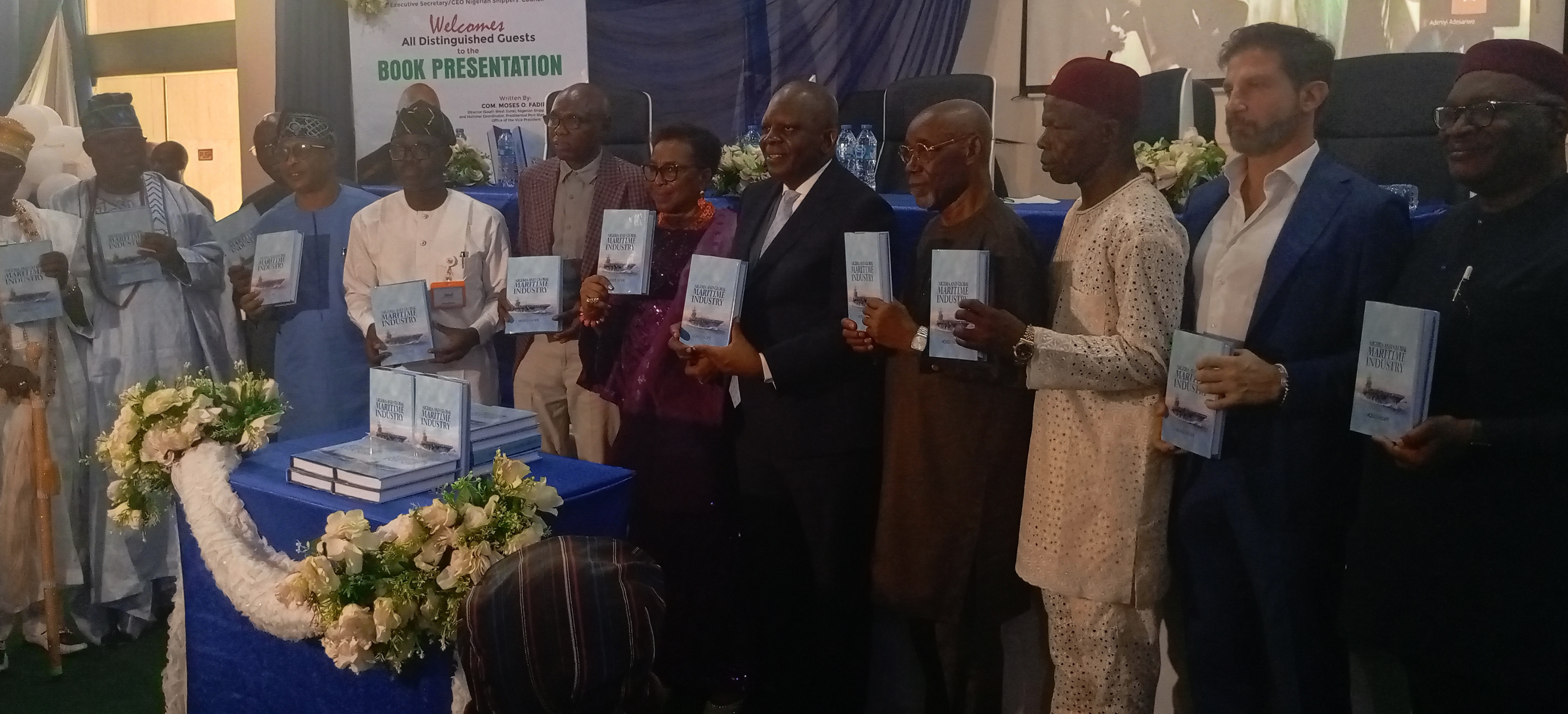

The Minister of Marine and Blue Economy, Adegboyega Oyetola, on Thursday joined eminent figures in the maritime industry, including the former Managing Director, Nigerian Ports Authority (NPA) Chief Adebayo Sarumi, and Executive Secretary, Nigerian Shippers’ Council, Barr. Pius Akutah Ukeyima, to celebrate the book launch of the National Coordinator of the Presidential Port Standing Task Team (PSTT), Moses Fadipe’s “Nigeria and the Global Maritime Industry.”
The event, held at the Nigerian Institute of International Affairs (NIIA) in Victoria Island, Lagos, drew a distinguished audience, among them Managing Director of PTML, Ascanio Russo; former Managing Director of the National Inland Waterways Authority (NIWA), Mrs Chinwe Ezenwa, former National President, Association of Nigeria Licensed Customs Agents (ANLCA), Prince Olayiwola Shittu, representatives of Nigeria Customs Service; Independent Corrupt Practices and Other Related Offences Commission (ICPC), Department of State Security (DSS), terminal operators and royal fathers.
The 382-page book, a comprehensive exploration of Nigeria’s maritime evolution, received accolades from industry leaders for its timely insights and potential to shape the nation’s maritime trajectory.

Speaking at the book launch, Oyetola commended Fadipe as a front runner dedicated to national interests, emphasizing his valuable contributions to the maritime sector.
Stressing the book’s timeliness, Oyetola who was represented by Olayinka Olusanya urged collective efforts to develop the gold-spinning potential of the maritime sector.
He emphasized the need for actionable steps and the implementation of insights from Fadipe’s book, calling for a shift from crude oil dependence to promoting the maritime sector for national benefit.
“In order to add value to the gross domestic product and economic economic growth, it is expedient that the maritime sector be given a keen attention. We shouldn’t just do the talking we should actionalise the talking. We should go to the next level of ensuring that we implement everything that he has put in this book for the overall benefit of the nation, ” he said.
In his remarks, Pius Akutah highlighted the critical timing of the book launch, praising Fadipe’s dynamism and dedication to service.
He acknowledged Fadipe’s instrumental role in advancing the Presidential Standing Task Team’s objectives, especially in freeing the port corridor and enhancing efficiency.
His words, “I met Mr. Fadipe just in November of last year when I resume as the ES NSC. And immediately, I saw in him, someone who is very restless. Someone that when you give him an opportunity to serve, you should not be worried about whether he will succeed or not. You should be worried about the extent to which success he will achieved.
“He has taken the work of the presidential standing task team to a height that was never imagined. We saw what he did to free the port corridor in terms of the madness that was going on there. And to try to bring about efficiency of the port system to encourage volume of trade in the country.”
Akutah stressed the significance of Fadipe’s 30 years of personal experiences compiled in the book, considering it a valuable resource for the sector’s advancement.
He also urged retired professionals and industry stakeholders to contribute their expertise for the maritime sector’s progress.
The book reviewer, CEO, Convention on Business Integrity (CBI), Olusoji Apampa, described Fadipe’s book as a symphony with five parts.
Apampa praised the book’s comprehensive exploration of the international trade theater, highlighting the strategic role of the maritime sector in Africa and its gateway position to global trade.
He said the book also detailed Nigeria’s maritime challenges and the efforts to enhance infrastructure.
He said, “In the first part of the book, the author invites you with tantalizing statistics for you to trace this projection of where the maritime sector is going globally and its potential impact on Africa.
“But the scond Symphony, which will be very exciting to many people, is that he now traces the history of the sector in Nigeria, not many people are aware of that. The trouble that they had to go through to dredge the connection to the channel to Lagos lagoon, to be able to admit ships into the Lagos lagoon was an eye opener for me.”
Author of the book, Moses Fadipe, highlighted the book’s synopsis of Nigeria’s maritime evolution, its global comparisons, and the exploration of the nation’s current standing.
He said, the book, beyond being a historical record, aims to offer insights for students, academicians, and government personnel to shape the future of Nigeria’s maritime industry.
“We looked at how the nation’s maritime sector evolved vis a vis global maritime development looking at how successful Nigeria is, all over the years, and how more successful the global nations are even when they have less than 20% from what our maritime coastline was from their water front.
“The question will be asking ourselves is why are other nations that are not as big as Nigeria thriving and successful.
“Why is Nigeria where we are? That was one of the inspiration of that book to know where Nigeria starts from and where we are with good policies from government why has it not giving the desired result,” he said.
More to read
Omi Eko: Management clarifies project implementation process
Customs intercepts N3.67bn cannabis-infused cookies, gummies from Canada at Tin Can port
Navy uncovers 40,000 litres of suspected crude oil in Delta