



The Nigerian Navy and delegates from 15 countries including African head of navies have resolved to initiate and drive the development of a comprehensive framework to govern and manage the Blue economy in the Gulf of Guinea and Africa.
This was part of the resolutions reached at the end of a two – day International Maritime Conference hosted by the Nigerian Navy at the Naval Dockyard in Lagos towards improving maritime governance and security in the African continent.
The Conference has the theme ‘Promoting the Blue Economy in Africa through International Cooperation on Maritime Security’.
Secetary General, Maritime Organization of West and Central Africa,, Dr. Paul Adalikwu in his paper presentation titled “Leveraging Maritime Security Collaboration for Harnessing Blue Economy in Africa: Strategies and Mechanisms for Success’ on Friday highlighted mechanisms through which cooperation for maritime security would improve the Blue Economy in Africa.
Adalikwu urged African countries to leverage on their bilateral, trilateral and multilateral bodies to foster collaboration for maritime security through specialised technical bodies to achieve combined maritime security forces at various levels.
A communique issued on Friday and signed by Chief of Policy and Plans, Nigerian Navy, Rear Admiral Joseph Akpan, said the Conference also agreed to sensitize respective governments on the need to establish a combination of marine and maritime data for mandatory baseline for the development of the Blue Economy.
The Conference attended by 400 delegates from 15 countries including African heads of navies and coastguards, maritime security experts, academics, private sector representatives, international partners, and civil society organizations also agreed on the development of funding mechanism to encourage indigenous shipping and infrastructural development.
Other resolutions include to “Facilitate a whole-of- government approach in developing Africa’s Blue Economy through regular meetings, workshops and joint exercises to enhance coordination, collaboration and communication with all relevant stakeholders.
“Facilitate the establishment of special funding such as the Maritime Security Trust Fund to fund maritime security operations for member states.
“Foster public-private partnerships (PPPs) involving governments, maritime industry stakeholders, shipping companies, port operators, and security firms to enhance maritime security capabilities and promote the Blue Economy.
“Develop human resource capacity in the Blue Economy in areas such as oceanographic research, ship building and maritime security.
“Encourage joint production of naval hardware especially ships and boats to minimize cost and promote uniformity in manufacture or acquisition of operational equipment towards enhancing interoperability.
“Seek the participation of maritime security forces at the planning stages of major investments projects in the Blue Economy.
“Encourage regular meetings between the political and military strategic leadership of member states.
“Improve and promote the welfare and socio-economic well-being of coastal communities to mitigate maritime insecurity towards developing the Blue Economy.”
The communique also disclosed that Heads of Navies/Coastguards agreed to give impetus to the operationalization and sustainability of the Combined Maritime Task Force (CMTF) in the GoG.
“Set up regional maritime information fusion centers to foster collaboration and information sharing among participating countries, law enforcement agencies, navies, and maritime industry stakeholders.
“Enhance the capacity of fusion centers through technology, training, and technical assistance to improve their effectiveness in supporting maritime security operations.
“Drive regional concerted efforts to combat IUU fishing and other maritime crimes in the GoG.
“Sustain and improve training on maritime security for the Blue Economy by tailoring training and exercises to reflect the fundamentals of the Blue Economy.
“Sustain and improve on regional and international collaboration while also seeking international support.
“The Nigerian Navy should organise the IMC/Fleet Review at her 70th Anniversary.”
Other participants at the Conference
were representatives from the European Union (EU) and other allied friends of the Nigerian Navy like Benin Republic, Canada, Cameroun, China, Equatorial Guinea, Egypt, France, Ghana, Pakistan, Republic of Congo, Senegal, Spain, South Korea and USA.
There was also representation from the International Maritime Organization (IMO), Interpol, as well as regional security and political organizations like the African Union (AU), Economic Community of West African States (ECOWAS), Economic Community of Central African States (ECCAS), Gulf of Guinea Commission (GGC) and the Inter-regional Coordination Centre (ICC) in Yaoundé, Cameroon.
Others include eminent retired and serving senior military officers, accomplished scholars on maritime security and blue economy, captains of industry, international maritime partners as well as relevant local and international maritime stakeholders.
“All presentations and discussion focused on four thematic areas which were maritime governance, sub-regional, regional and international collaboration, information gathering, processing and sharing and improved funding for infrastructural development.
“Subsequently there would be a meeting between the Heads of Navies and Coast Guards,” the communique stated.
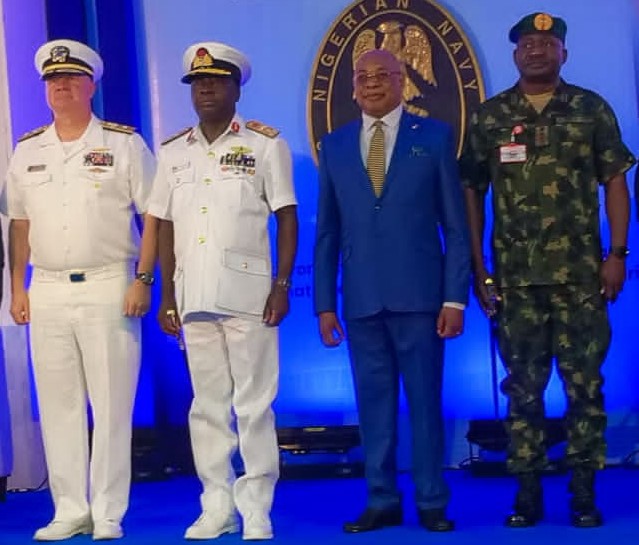
Photo caption:
R-L: Chief of Defence Staff, Gen. Christopher Gwabin Musa; Secretary-General, Maritime Organisation of West and Central Africa, Dr. Paul Adalikwu; Chief of Naval Staff, Vice Admiral Emmanuel Ogalla; and the moderator of the discussion session at the closing ceremony of the International Maritime Conference and Nigerian Navy’s 68th anniversary in Lagos on Friday.
More to read
Customs pledges support for Nigeria’s $1tn economy target
MWUN PG Bunu celebrates Adeyanju on birthday, hails contributions to labour movement
After revenue, export gains in Ogun I, Afeni takes over Customs FOU A