


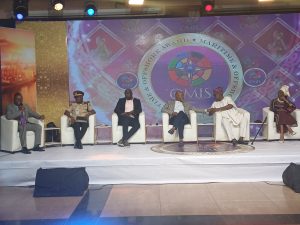
Maritime industry stakeholders have called for a framework and effective collaboration among relevant government agencies to address threats to Nigeria’s maritime security.
The stakeholders at the Maritime & Offshore Award (The OMIS) held weekend in Lagos with the theme ‘Maritime Safety and Security’ identified drug trafficking, arm smuggling, Illegal, Unreported and Unregulated Fishing, piracy and armed robbery at sea as some of the biggest threats to Nigeria’ s maritime security.
Speaking at the event, President, Maritime Security Providers Association of Nigeria (MASPAN), Emmanuel Maiguwa noted that despite Nigeria’s high level of compliance with the International Ship & Port Facility Security (ISPS) code, drugs and arm trafficking as well as other criminal activities have persisted in the nation’s maritime environment due to the absence of an appropriate framework.

He said, “Currently, the only instrument that we have that enables us to improve on our security is the ISPS and if you audit our ports today, they are perfectly in compliance with ISPS.
“But we still have cases of human trafficking. Every time ships come to our ports; we find stowaways and sometimes we discover them when they have reached Brazil but then we are on security level one using the ISPC. We still have drug trafficking through the sea almost on a monthly basis, we have arrest by NDLEA in our ports of drugs coming, same with arms trafficking through the seaports and illegal fishing We have not recorded piracy in the last one year in Nigerian waters but somewhere in the Gulf of Guinea, we all know they are still coming from the shores somewhere.
“So why do we still have the threats even when we have some level of compliance? I will say the absence of an appropriate framework. Currently, we have the Armed Forces Act which gives the Nigerian Navy a responsibility to assist in the enforcement of customs regulations which deals with arms trafficking, assist in enforcement of immigration and regulations which also deals with human trafficking. NDLEA and NIMASA are also to assist in the enforcement but the threats have evolved into something else that we need a new framework.
“The ISPC code provides a minimum regulation for countries to adopt. This is an IMO advocacy. IMO does not understand our peculiar problems in Nigerian and they are not there to solve the problems but they look at what affects shipping generally and try to adopt regulations that will be mandatory for everyone to be able to comply so they cannot set the bar high.
“So, no matter how much the NPA implements the ISPS regulations, humans will still be trafficked, drugs and arms will come in because of the other facility that is not an ISPS facility. So, we don’t have that framework and unless we have that framework, we will just be doing what they call merry go round.”
Maiguwa who is also the President, Alumni of Maritime Academy of Nigeria Oron (AMANO) called on the ministry of Marine and Blue Economy to partner with the ministries of Defence and Interior in establishing a new framework to tackle the security challenges in the maritime environment.
“The ministry of Maritime and Blue Economy should first sit with other ministries like the Interior, Defence and agree that there has to be a framework for maritime security because the ministry of marine and blue economy cannot do it alone in the sense that they will need immigration, customs and the Nigerian Navy. At the ministerial level, when they agree, they can come down to the experts in the maritime industry and then set up a committee and propose a framework
“Every government agency acts unilaterally so the maritime administrator is not even aware of what is happening. The coordination is missing so if those ministries don’t come to support nothing will happen,” he said.
In his submission, the Executive Secretary, Nigerian Shippers’ Council, Emmanuel Jime, advocated for the implementation of the Cargo Tracking Note (CTN) being championed by the Council to curb the menace of illegal firearms, dangerous and fake products smuggled into the country through the nation’s seaports.
“If we implement the CTN, we will be able to have a structure that we can define. The major threat in maritime security is fake products, illegal firearms trafficking, narcotics, illegal bunkering and smuggling. If we want to address these problems, there is a need for us as a nation to look at the CTN which is meant to enhance the security and safety values for the shippers and assist the relevant government agencies on risk mitigation. With that you will be able to know what is coming in right from the port of origin. The other subregional countries around us operate CTN. Why are we not operating CTN?
“We need to put up structures that can ensure that the amount of time spent in the port is reduced and we believed that the implementation of CTN is the surest way to ensuring that people can have the confidence needed in our shipping sector,” Jime who was represented by the NSC’s Director of Planning and Research, Rotimi Anifowoshe said.
Meanwhile, some eminent maritime industry personalities and organizations have been honoured by the OMIS for their excellent contribution to the development of the sector.

Among those honoured are the Permanent Secretary, Ministry of Marine and Blue Economy, Dr. Magdalene Ajani, Chairman, Starzs Investment Company Limited, Engr Greg Ogbeifun; former Lagos Port Manager, Mrs Funmilayo Olotu and National Coordinator, Port Standing Task Team, Moses Fadipe.

Others are former Managing Director, National Inland Waterways Authority (NIWA) Mrs Chinwe Ezenwa and President Shipowners Association of Nigeria (SOAN) McGeorge Onyung who were both presented with the OMIS Lifetime Achievement Award while the OMIS Posthumous Award was given to late Chairman, African Shipowners Forum, Mrs. Margret Orakwusi.
More to read
NRS, Customs, PEBEC assess NSW progress, to engage terminal operators on demurrage waivers
Shippers’ Council achieves full digitization via ECMS- Akutah
60 shipowners jostle for cabotage fund as NIMASA pledges transparent disbursement