


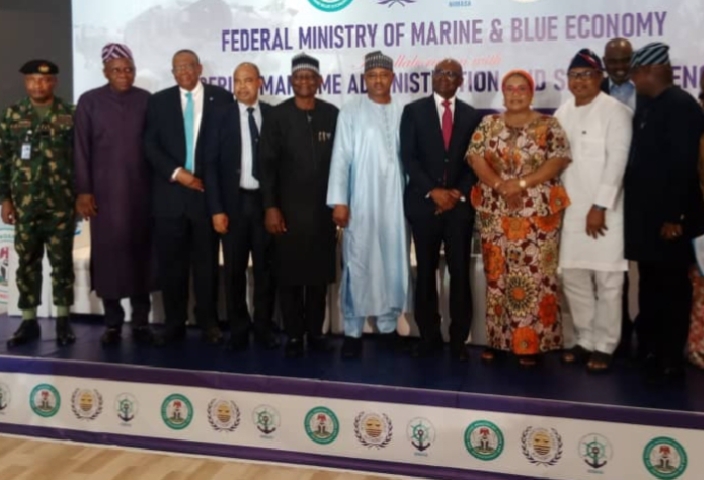
Speaking at a stakeholders’ sensitization workshop on deep seabed activities organised by the Ministry in collaboration with the Nigerian Maritime Administration and Safety Agency ( NIMASA) in Abuja on Wednesday, Minister of Marine and Blue Economy, Adegboyega Oyetola emphasized that Nigeria’s extensive coastline and inland waterways make it an ideal player in the emerging deep-sea exploration sector.
Represented by the Permanent Secretary of the Ministry, Oloruntola Olufemi, Oyetola added that the transition from a fossil fuel-based to a mineral-based economy also presents opportunities for Nigeria to leverage its marine resources, particularly wave and tide energy, to generate clean energy.

He noted that effective utilization of these resources will substantially contribute to Nigeria’s energy needs.
He said, “Nigeria’s establishment of a full-fledged Ministry of Marine and Blue Economy in 2023 demonstrates our commitment to diversifying our economy and capitalizing on the global surge in deep-sea exploration. As a major oil-producing country with an extensive coastline and inland waterways, we cannot afford to lag in this new frontier.
“This workshop aims to raise awareness among critical stakeholders about the importance of Deep Seabed exploration and exploitation, addressing environmental and social implications and ensuring effective protection of the marine environment from harmful effects that may arise from deep seabed activities.”
Also speaking, Director, Maritime Safety and Security, Bombata Babatunde, said the Ministry and NIMASA remains committed to promoting collaborative efforts with key industry players, driving innovation, and championing sustainability.
“As we convene here today, we acknowledge the relatively uncharted terrain of deep seabed activities. The workshop aims to illuminate the opportunities and importance of exploring Africa’s continental shelf while ensuring responsible environmental management and adherence to regulatory frameworks, “he said.
In his presentation, the Director General of NIMASA, Dr. Dayo Mobereola stated that deep seabed exploration and mining offer a unique opportunity for Nigeria to expand its maritime resources, align with the global shift towards sustainable development, and promote economic growth.
Among other benefits, Mobereola said deep seabed mining activities would create thousands of jobs and unlock new revenue streams, thereby contributing significantly to Nigeria’s GDP.
He said, “Exploring deep seabed mining holds the key to new revenue streams/economic benefits as you gain access to unexploited mineral resources. It is estimated that global demands for some of such minerals will rise as much as 400-600% in the coming decades as the world increases its reliance on wind and solar power, electric vehicle batteries and other zero-carbon technologies.
“Reduced Carbon Print – Decarbonization
Technological innovation arising from the development of specialized equipment and techniques.
“Job creation: Employment opportunities in exploration, extraction and processing.
Economic diversification.
Sustainable resource management.
Ocean based renewable energy integration.
“Research and Development.
Eco – tourism and conservation.
Reduced reliance on land based mining which will decrease environmental impact on land.”
He said for nigeria to fully maximize and benefit from it’s deep seabed mining activities, there is need for a robust legislation for seabed mining, stakeholders engagement and thorough environment impact assessments to minimize potential damage to ecosystems.
His words, “NIMASA will play a critical role by collaborating with relevant MDAs and the International Seabed Authority (ISA) in providing the regulatory framework and establishing environmental protection guidelines for seabed mining.
“The Agency could also help develop training programs to grow local expertise in deep seabed mining technologies and operations. Promote Research and Development in marine science and technology to enhance knowledge of deep-sea ecosystems and resource potential.
“We remain committed to ensuring that relevant legislative frameworks on the sustainable use of the Marine Environment and Safety standards are fully implemented.
“It is also crucial that the Nigerian Minerals and Mining Act 2007 is amended to reflect relevant provisions of ISA’s model of legislation on exploration and exploitation.
“Nigeria has long benefited from its offshore oil and gas resources. As we look to the future, deep sea mining presents a unique opportunity for Nigeria to diversify its economy and secure long-term economic growth. It is an integral part of the Blue Economy, promising technological advancement, resource security, and job creation. However, this potential can only be realized if we proactively address the associated environmental, technical, and regulatory challenges,” he said.
In his remarks, the Minister of Solid Minerals Development, Dele Alake, said the ministry is looking at developing a legal and regulatory structure that will govern deep-seabed mining in Nigeria, ensuring that it contributes significantly to national economic growth in the nearest future.
“As the Ministry directly responsible for solid minerals development in Nigeria, we are aware of the need for a comprehensive regulatory framework tailored to deep-seabed mining. The seabed holds enormous potential for diversifying Nigeria’s resource base but its exploration and exploitation must be guided by global best practices, with due consideration given to environmental stewardship, ” Alake who was represented by the Ministry’s Permanent Secretary, Mary Ogbe said.
More to read
Nigeria, Spain deepen naval cooperation to bolster Gulf of Guinea security
NRS, Customs, PEBEC assess NSW progress, to engage terminal operators on demurrage waivers
Shippers’ Council achieves full digitization via ECMS- Akutah