


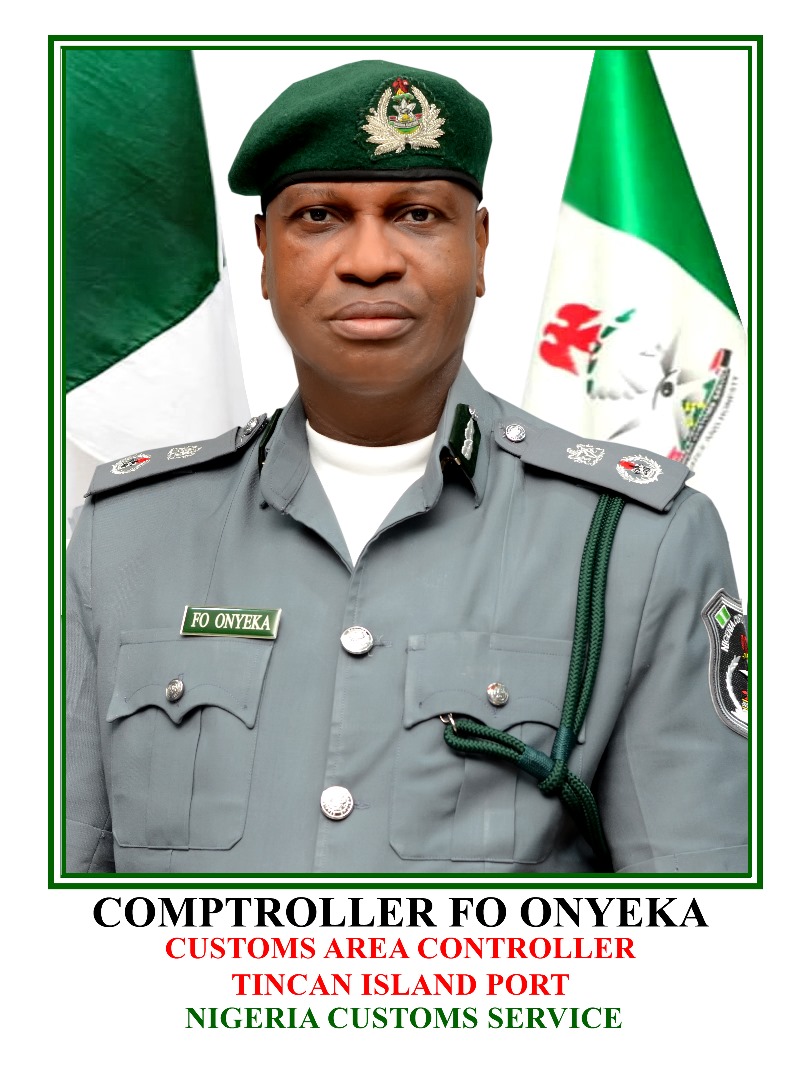
The Tin Can Island Port Command of the Nigeria Customs Service (NCS) last week announced a landmark revenue performance for the 2025 fiscal year. Generating a record ₦1.56 trillion with a surplus of ₦51.8 billion as at December 23rd 2025, the command attributed the feat to targeted administrative reforms, improved processes and collective responsibility.
In this interview with journalists to review the command’s 2025 operational activities, Comptroller Frank Onyeka revealed that while the importation of bulk cargo, general merchandise and used vehicles remained the major drivers of the Command’s revenue profile, interventions such as demand notices to recover under payments, and the implementation of the One- Stop shop initiative- designed to eliminate multiple alerts and delays- fuelled the command’s unprecedented revenue profile.
Comptroller Onyeka, also spoke about his 10:00 PM work ethic and the personal challenge of succeeding DCG Dera Nnadi, whose legacy, he said, left very big shoes to fill.

Shulammite Olowofoyeku was there for Maritime Today Online
Excerpts:
To what do you attribute the landmark revenue milestone of N1. 56tr?
This growth did not happen by chance; it is the outcome of deliberate reforms, improved processes, and collective responsibility.
Our major revenue contributors remain bulk cargo, general merchandise, and the importation of used vehicles, which constitute a significant volume of trade passing through the Port. Through diligent cargo examination, and strict adherence to customs procedures, the Command ensured that government revenue due on these imports was fully collected.
One of our key focus areas in 2025 was the elimination of revenue leakages and operational inefficiencies. We deliberately addressed the issue of multiple and unnecessary alerts, which had previously slowed down clearance processes and created room for abuse. By streamlining alerts and strengthening internal coordination, we improved efficiency while maintaining effective control.
We also made conscious efforts to create an enabling environment for legitimate trade and to this end, the Command sustained regular and meaningful engagement with stakeholders which included importers, licensed customs agents, terminal operators, and shipping companies among others.
So I can proudly tell you that I’m one of the most fortunate Customs officers. I must appreciate my stakeholders; when we came in, the situation was challenging, but they supported me and listened. I also need to thank God and the Comptroller General of Customs for giving me maximum support. It is about the confidence people had in us—we were able to do more because of that confidence.
How did interventions like Demand Notices contribute to this revenue profile?
There is no magic, just diligence. As far as I am concerned, you cannot have a perfect SGD (Single Goods Declaration). As a valuation officer, I can tell you for free that out of every 10 SGDs, Demand Notices are issued for a minimum of 5 to 6 on a daily basis. So, if I have 100 SGDs, about 62% to 63% go on Demand Notices. That added significantly to my revenue profile. I still have to pass it back to my stakeholders and trading partners for believing in us and letting that work.
You’ve been a strong advocate for the One-Stop Shop initiative. How has that impacted trade facilitation at Tin Can command?
One-Stop Shop is something I implemented even before I came here. I started it before it was graciously approved by the CGC. The goal was simple- to eliminate multiple alerts. We are 21st-century Customs officers; we don’t “choke” trade. If traders are being choked elsewhere and they are not being choked here, they will come back. That is why our space is being used more frequently now and that also boosted our revenue profile.
In the area of trade facilitation, how many days does it take for a container to exit the port?
Let’’s be realistic. If there are no issues and you are a compliant trader, you can get your container out after assessment in 48 hours. The appeal I’m sending across is: declare appropriately, perform examination, and pay your duties. If you do that, you can be sure to exit your containers within two days.
You are known for staying in the office until very late. Why is that necessary?
I leave the office not less than 10 p.m. every day. We stay late because I know there are problems, and the only way to address them is to stay and listen. If you come here at 10 p.m., I will listen to you. My stakeholders know that at any time, the Controller is always available. Someone said recently – I wasn’t massaging his ego, but that’s the truth—you see me anywhere, accost me, and I’ll sit down with you and listen.
What was the major challenge you had to contend with during this period?
My greatest challenge was succeeding DCG Dera Nnadi and fiitting into the big shoes he left. DCG Nnadi did exceptionally well. He had experience as Controller in Seme and Idiroko commands before he came to Tin Can command. But I came in as a Deputy Comptroller, having just been a “gateman” somewhere at Apapa port with no experience. People reminded me I had big shoes to wear. How do I fit in? I had to run to God. I appreciate my brother and boss, DCG Nnadi, for his coded assistance. It wasn’t easy, but to the glory of God, we are where we are today.
Looking toward 2026, what should the industry expect from your command?
That lies in the hands of God. I have the best team, but without the backing of God and the CGC, you are going nowhere. My core mandates—revenue generation, suppression of smuggling, and trade facilitation- bearing in mind national security- are not negotiable. As long as those remain my basic ethos, expect the best from me. With your support and God’s grace, nothing is impossible.
More to read
Clearing agents decry NPA license approval delays, warn of port disruptions
MSC signs 45-year concession with Nigerdock to develop Snake Island container terminal
CNS tasks commanders to leverage intelligence, tech to boost naval operations