


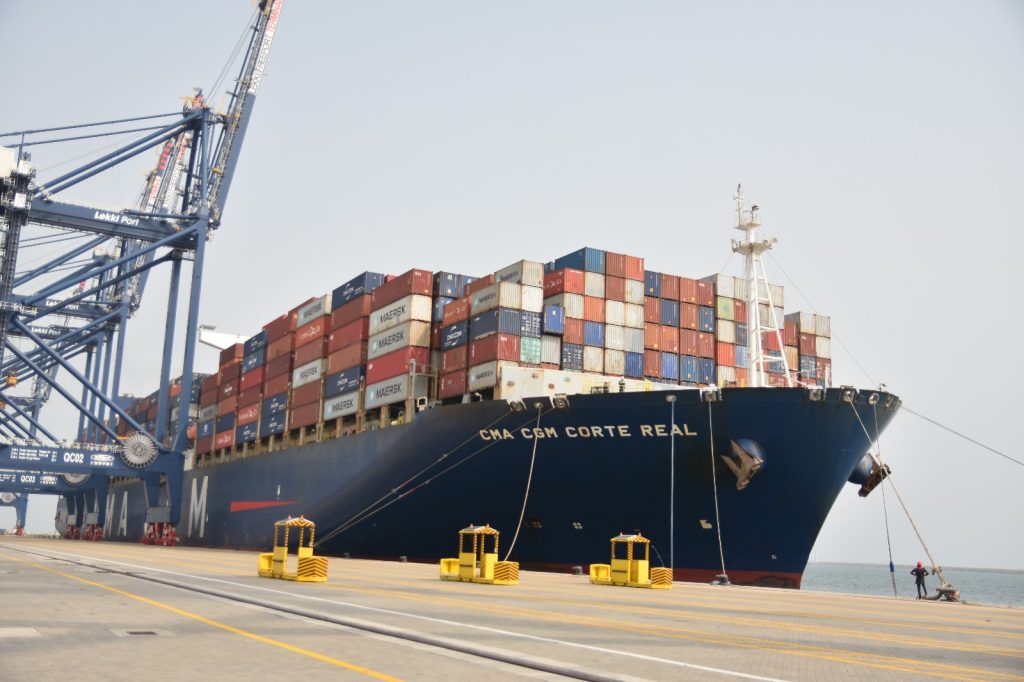
The management of Lekki deep seaport has declared an ambitious goal to achieve the position of Nigeria’s overall premier port following the confirmation that it has successfully displaced Tin Can Island Port as the country’s second-largest port by trade value.
New trade data for the first nine months of 2025 confirms a significant structural shift in cargo movement, with Lekki port surpassing both the Tin Can Island and Port Harcourt (Onne) ports in both imports and exports.
According to the data drawn from Nigeria’s “Trade by Top 10 Posts/Ports of Operation” tables for Q1, Q2, and Q3 2025, Lekki Deep Sea Port handled an estimated N13.46 trillion in total trade—a combined value of imports and exports. This figure firmly establishes it as Nigeria’s second-largest gateway, placing it well ahead of Tin Can Island’s N9.31 trillion and nearly doubling Port Harcourt (Onne)’s N6.76 trillion.
While Apapa Port remains dominant with approximately N74.78 trillion in total trade, Lekki has emerged as the only port operating at a scale significant enough to function as a genuine secondary hub.
Reacting to the development during an experiential visit to the facility by journalists on Tuesday, the Managing Director/Chief Executive Officer of Lekki Port LFTZ Enterprise Limited, Mr. Wang Qiang expressed confidence in the port’s rapid growth.
He said the port is currently operating at half of its installed capacity of 1.2 million Twenty- foot Equivalent Unit (Teus) recording a steady month-on-month growth in container throughput.
“Almost 50 per cent of the port capacity has already been attained. From September to October, every month we put more than 55,000 TEU. Due to that progress, we already reached up to 50% of our capacity now,” he said.
The milestone, he said, reflects increased confidence from shipping lines and cargo owners in Nigeria’s first deep seaport.
To sustain and accelerate this growth, Qiang stressed the imperative of efficient multimodal connectivity.
He highlighted that barge operations have become an important evacuation channel, currently accounting for about 10 per cent of cargo movement from the port.
Operationally, he said the port operates on a 24-hour basis with advanced technology like automated gates, and scanners to ensure efficient movement of cargoes.
While acknowledging that the ongoing Lagos–Calabar Coastal Road project will help ease congestion and improve access, the Lekki port MD emphasised that rail connectivity remains essential to match the scale of industrial activities emerging within the Lekki corridor.
“I believe the train option is something the government is concerned about, and with the level of industrial activities in this region, we expect that it will be provided,” he stated.
He noted that while the port is fully automated, delays may persist until all stakeholders, particularly government agencies, fully align with end-to-end digital processes.
He explained that Customs procedures, especially physical cargo examinations, and other port services must be fully digitalised to significantly reduce cargo dwell time.
“For automation to work efficiently, all players must be ready – customers, government and every stakeholder. Only then can we have a fantastic system,” he added, stressing that improved connectivity and optimisation could effectively double the port’s capacity without expanding its physical footprint.
Also speaking, Chief Executive Officer of Lekki Freeport Terminal (LFT), Captain Jedrzej Mierzewski, declared the port’s ambition, stating, “We will be the biggest and number one. Why? Because we are the best. We have the best equipment and we are the most modern port.”
He noted that after only two years of operations, LFT is already the second-largest terminal in the Nigerian market.
Captain Mierzewski attributed the rapid growth to the port’s modern infrastructure and operational excellence compared to the rather obsolete nature of older Nigerian ports.
“We are the fastest-growing terminal in the country, combining modern infrastructure, operational excellence, and a clear ambition to become a leading transshipment hub for West Africa. Our growth supports the Nigerian economy by strengthening trade connectivity and helping to reduce the cost of foreign trade through efficient, reliable, and competitive port services,” he said.
More to read
NRS, Customs, PEBEC assess NSW progress, to engage terminal operators on demurrage waivers
Shippers’ Council achieves full digitization via ECMS- Akutah
60 shipowners jostle for cabotage fund as NIMASA pledges transparent disbursement