


…Lauds firm’s achievements
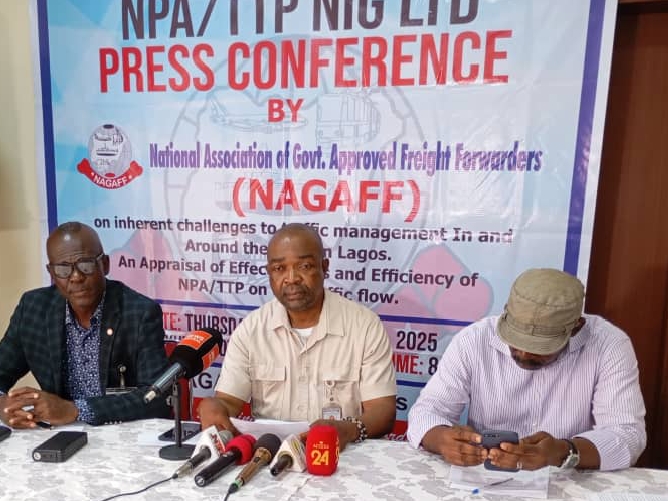
The National Association of Government Approved Freight Forwarders (NAGAFF) has urged the Nigerian Ports Authority (NPA) to promptly renew its contract with Truck Transit Park Limited (TTP) in order to sustain the free flow of truck movement along the Lagos ports corridor.
Speaking at a press briefing to assess the traffic flow in the port corridors of Apapa and Tin Can in Lagos on Thursday, President of NAGAFF, Tochukwu Ezizi, stated that TTP’s contract with the NPA is set to expire next year.

According to him, TTP has submitted several applications to NPA, including a proposal for an e-Tag system to further streamline truck entry and exit but yet to secure an approval.
Represented by the association’s Secretary General, Godfrey Nwosu, Ezizi
said, “The contract of TTP will expire by next year. They have presented several applications to NPA which is still lying on the table of the Authority for approval. One of those things they have presented is the need for the NPA to approve the use of e-Tag in accessing the port and exiting the port but approval hasn’t been given,”
Ezizi stated that within two years of operation, the company through its digital traffic management system, Eto, has resolved the chronic traffic gridlock that once crippled business activities in the Lagos’s port corridors.
“We vividly recall with nostalgia, the harrowing experiences endured by port operators prior to the arrival of TTP. During that time, business activities were nearly crippled. Many companies were forced to shut down operations and relocate from Apapa, and in many cases, from Lagos entirely. Property and real estate values plummeted. Both the federal and state governments suffered significant revenue losses. Several traffic decongestion task forces and measures were implemented, but the problems persisted.
“However, thanks to the ingenuity of the NPA and the former Ministry of Transportation, a strategic decision was made to engage the services of TTP. In less than two years, the positive impact of their digital traffic management operations began to manifest. The once intractable traffic gridlock started to ease, and port operators breathed a sigh of relief.
“Within the period under review, the eye witness account can authoritatively report the positive outcomes of improved traffic management in the Apapa and Tin-Can Island port corridors. This is a direct result of the federal government’s traffic management reform policy, aimed at facilitating the smooth flow of freight and logistics operations, ” he said.
Making a case for continued engagement of TTP, Ezizi, said the company has processed 2.7 million truck movements through the Eto system, reducing the cost of transporting cargo to and from Lagos ports by 65 percent and slashing truck turnaround time from 2-3 weeks to less than three days.
Also speaking, a former president of NAGAFF, Increase Uche said whereas fewer than 50 trucks could be evacuated daily in the pre-Eto era, the FMCG and Oil & Gas industries can now evacuate over 400 trucks per day.
He added, “TTP’s operations have had a profound impact on trade facilitation. Delays in the movement of export goods have been drastically reduced. Nigerian exporters are no longer required by overseas buyers to provide performance bonds during sales contracts. Export containers from the hinterlands are now arriving at the ports in a more timely and predictable manner.
“In the real estate sector, property values in Apapa have appreciated significantly. According to our research, the Eto technology has directly created around 225 jobs, and empowered over 500 ancillary workers within the port environment. ”
While acknowledging that more needs to be done, the association urged the government to sustain and consolidate the achievements.
The NAGAFF President sressed the need for political will to monitor and ensure service providers like TTP maintain their high standards.
“The old tradition of failing to build upon progress should be discarded.
“The government must develop the political will to monitor and ensure that the standards set by service providers like TTP are maintained. Globally, modern ports are developing and tilting towards efficient and effective service delivery to port users to reduce port cost and excessive delays.
“This feat is quite encouraging and also the more reason TTP, an indigenous service provider that has proven Nigeria’s capacity to solve long-standing logistical challenges, deserves continued support and encouragement,” he said.
More to read
NRS, Customs, PEBEC assess NSW progress, to engage terminal operators on demurrage waivers
Shippers’ Council achieves full digitization via ECMS- Akutah
60 shipowners jostle for cabotage fund as NIMASA pledges transparent disbursement