


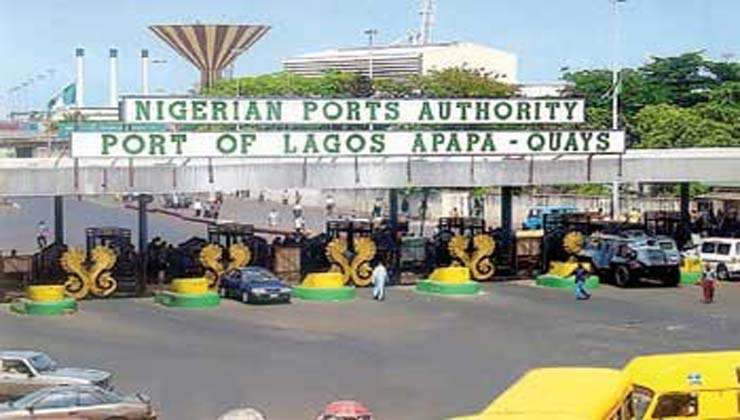
Despite being West Africa’s largest economy and a major regional player, no Nigerian port secured a spot in the Lloyd’s List’s Top 100 Container Ports Ranking for 2025.
The absence of Nigerian ports year- on year highlights severe infrastructure deficiencies and logistical constraints that continue to hobble the nation’s maritime sector, even as global container traffic rebounds strongly.
According to the Lloyd’s List’s latest assessment, worldwide throughput reached 743.6 million twenty-foot equivalent units (teu) in 2024, an 8.1% increase from the previous year.

The 2025 assessment confirmed that only four ports in Africa managed to break into the Top 100 list, despite a global rebound in trade volumes.
The highest-ranked African port is Tanger Med, Morocco, which secured the 17th global spot with a significant throughput of 10,241,392 TEUs in 2024.
The other three are Port Said, Egypt ranking 53rd with 3,905,266 Teu, Alexandria, Egypt at 90th position with 2,211,851 Teu and Lome Togo securing the 92nd position with 2,060,435 Teu.
Asia continues to dominate global trade flows, with Chinese ports alone responsible for over 40% of total container throughput.
North America and Europe also gained momentum, supported by shifting supply chains, stronger consumer spending and strategic inventory replenishment.
In the top 10 ranking index, Port of Shanghai, China occupied number one position, Singapore port ranked second, port of Ningbo-Zhoushan, China ranked third, port of Shenzhen, China ranked 4th, port of Qingdao, China ranked 5th, port of Guangzhou, China ranked 6th, port of Busan, South Korea ranked 7th, port of Tianjin, China ranked 8th, Jebel Ali port, United Arab Emirates, ranked 9th while port Klang, Malaysia ranked 10th respectively.
Nigeria’s failure to make the global Top 100 list is a direct result of deep-seated challenges plaguing its major trade gateways, particularly the Apapa and Tin Can Island ports in Lagos, which handle the majority of the nation’s cargo.
A major contributing factor to the low global competitiveness is inefficiencies at the ports, ranging from congestion to poor infrastructure and lack of automation.
Nigerian ports struggle with dilapidated facilities, outdated cargo-handling equipment, and shallow drafts, which severely limit their capacity to accommodate the larger container vessels now dominating global shipping routes.
To reverse this trend and unlock the nation’s vast trade potential, the government must prioritize infrastructure overhaul -deepening drafts and modernizing ports facilities, implementing full automation to eliminate bureaucratic bottlenecks and developing effective rail and road links to decongest ports and move cargo efficiently.
Without swift and decisive action on these fronts, Nigerian ports will continue to lag behind, risking further diversion of cargo to more streamlined neighbouring hubs and ceding Nigeria’s natural dominance in West African trade.
More to read
Clearing agents decry NPA license approval delays, warn of port disruptions
MSC signs 45-year concession with Nigerdock to develop Snake Island container terminal
CNS tasks commanders to leverage intelligence, tech to boost naval operations