


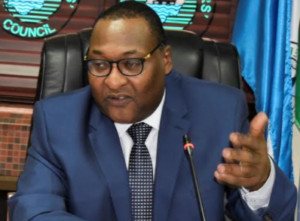
The former Executive Secretary, Nigerian Shippers’ Council (NSC) Mr. Hassan Bello in this exclusive interview with Maritime Today Online Shulammite Foyeku, lauded the efforts of the present NSC management led by Emmanuel Jime since assumption of office especially for being able to reach an agreement with shipping companies on cost reduction, a development which he admitted his administration couldn’t achieve. He also spoke on how the absence of rail capacity is eroding investors’ confidence from the nation’s seaports and Inland Container Depots (ICDs) among several other pertinent issues.
Excerpts:

What have you been preoccupied with since you left office?
I have been very busy. I am running a law firm and I’m involved in strategic thinking with the industry. Once you have the opportunity of working with the Nigerian Shippers’ Council, I guess you have to think at all times about how that sector of the economy can continue to grow. So, I am a member of a certain study group that is looking at the industry on what significant contribution the industry can make to the national economy.
I understand you’re seeking political ambition. How true is that?
No. That’s not true. I am apolitical in the sense of running for office and all that, I have no stomach for that. But I also know the difference between economy and politics but for now, I am more with the economy than politics.
You enjoyed cordial working relationships with stakeholders during your tenure as ES Shippers’ Council but it appears the reverse is the case with your successor as there are complaints that he hasn’t been meeting with stakeholders. What will you say to this?
That is absolutely not true. My successor is not a green horn. He is someone who has headed even a bigger parastatal than the Nigerian Shippers’ Council but he needs to study the sophisticated sector of shipping. When I read that he has not been meeting with investors, I know that was not correct because he has met with shipping companies, terminal operators, freight forwarders including the labour union. Even yesterday (Thursday), there was a meeting with the Consumer Protection Agency for them to sign a very important MoU so that they will look at the issue of competition in the industry. So, I think the press is putting the cart before the horse. You have to be patient and give him time. Jime is a very calm person and extremely intelligent. He also comes with what they call in Nigeria intimidating credentials so I’m sure if you give him a little time, you will see the manifestation of his well-thought-out ideas.
So, will you say you’re satisfied with the pace with which some of the projects you pursued vigorously while in office have been going on since you left?
Yes, I am satisfied with the pace because some things have been achieved already which we couldn’t achieve like the agreement with shipping companies for cost reduction. This has been going on for some time because negotiations will break because of one item and we will not be able to conclude. But I think everything has now been agreed and the first thing that this current management did was to say let us negotiate with individual shipping companies and I think that is brilliant. I was even ashamed why I didn’t think about that. So, it’s a brilliant administration going on at Shippers’ Council because it is anti-competition even to have all of them (shipping companies) come together and say this is applicable. Then where is the competition? If handling charges or whatever charges is X, it should not be uniform with all the shipping companies but there could be cuts, talks and in between competition will come into play. This is a very brilliant idea by the present management and if they do that a lot of things will be in place because when there is more competition, there will be more efficiency.
You led so many advocacies especially on development of Inland Container Depots (ICDs) but till date not one has become operational. What’s hindering the dry ports from taking off?
The mistake we made was to think that all of them would come on at the same time. It’s a private sector thing. During our administration we have to mollycoddle the investors, we have to protect them, spoil them because it was the initial stage but I’m happy now that we have Kano and Jos dry ports going on and soon, we will have foreign investors for the Ibadan ICD. The materialisation of this will solve a lot of problems. I read from the Infrastructure Concession Regulatory Commission (ICRC) saying that two of the dry ports will come into operation very soon. But one of the things I’m scared of is rail capacity because we must have investors and shippers’ confidence because rail must be scheduled so that you know that there is certainty and predictability. The Nigerian Railway Corporation and the Nigeria Customs Service have supported the dry ports wonderfully working together and I am sure the more rail capacity we have the more important the dry ports will be. I’m calling on the government to make the dry ports centre for exports so that you have pre-inspection facilities there so an exporter need not go to Lagos and have his consignment certified.
How about the issue of container deposit?
Yes, it is also going on but the last time I checked there have been meetings with the shipping companies. You know it is between two organisations- the Nigerian Shippers’ Council and the National Commission on Insurance and even the shipping lines have keyed into the idea because it is not good for them also to be collecting deposits for administrative costs and inconveniences.
Our ports are still lagging behind especially in terms of efficiency with decay infrastructure. How do we achieve a hub status in the sub region?
There is much to be done. I agree with you. Our port may be not competitive because a port is as good as how soon or how fast it can clear its cargo out. That we still have problems with in terms of infrastructure and access to the port and automation. But you know Shippers’ Council has been very good at pursuing that. We have some terminals that were 20, 30 percent but now they are at 60 percent because the Shippers’ Council has been on them. If you go to PTML for example, it’s almost 100 percent now. Nothing is done manually and the agents, shippers love going to that terminal because cargo exits faster than any other but then if the cargo exits, you’ ll see bad roads. The Shippers’ Council did work with the Nigerian Railway Corporation to introduce carriage by rails. I know there are still problems but I think the moment we realise that we have the Lekki deep seaport and the moment our competitors, the neighbouring countries know about the port, they have started shivering already because all the cargoes are destined to Nigeria. So, the Nigerian government must be commended for that Lekki port and the investors. However, I have always caution about multimodal access. It cannot be road alone. We cannot repeat the mistakes of Apapa in Lekki but the Ministry of Transportation now pays visits almost monthly to the port so that he would see how much this thing could be accelerated. It is a significant infrastructure development for Nigeria’s economy. The fact that Customs has also deployed scanners is a sign of progress I am sure soon they will be deployed.
Lagos ports are said to be operating beyond capacity hence there is need for us to develop other ports. Do you share a similar view?
Well, you have to look at what our throughput was years ago and that’s why we say some things are done without planning. That is why the Cargo Tracking Note is important for planning and that is why the Shippers’ Council is insisting on that. We will know how many ports we are going to build because of the statistics we get, everything coming to Nigeria, we must know. But Nigerian ports especially the Lagos ports- Tin Can and Apapa ports have limitations of being river ports and shallow draught so they can’t operate large ships and now it is the large ships that makes an economy. What that would mean is that there must be a hub somewhere and then in Lomé or Cotonou, the large ships will come and then smaller ships will come to Nigeria when we have the largest economy. Our economy must be merged with infrastructure and that is why the Lekki port is very important. At 16-metre draught, all the big ships will come and we will be the load centre, distributing to others. Afterall where is the market? It is here in Nigeria. So, for me, Tin Can and Apapa port honestly are relics and modern ports do not operate with shallow draught. But when you are in Lekki, you need less dredging. Tin can and Apapa need capital and maintenance dredging all the time. So, we need to develop more ports. Developing more ports is a definition of our ambition as a country. The moment we say we are going to have Lekki port, then the whole situation will change which means you are not going to be receiver of goods, but you are going to be the one to distribute them and the more throughputs we get, the more we create employment, the more our infrastructure will increase and the more you see us having standards.
All our exports will go through the port because now exporters have a limit to access the port but when Lekki comes on stream, we make sure that this does not happen and it is going to be a modern port. Everything will be digitalized unlike what you have here and we will not have the presence of people around the port because the port now is seeming unsightly. Anybody could have access to it. That is not how a port should be and people go there not for anything but for corruption. If we have a digital port, you won’t see anything. The Lekki seaport will be a transition to modernity then we will abandon the Tin can Apapa to their own divide. So, it will be either they change or they close because people will have options. Why would you go and have 21 days waiting for your cargo to exit? The cargo dwell time is one of the longest while the average is seven days in the region and that is what we should aim for. One day, it should be zero dwell time, things moving as soon as they come and that is one thing, I will want them to have a critical look at Lekki, there should not be any examination of cargo at the port of Lekki, cargo should go off dock, Ogun State, Oyo State in dry ports, bonded warehouse in other off dock facilities. Leave the port to just receive goods and send it to them. That is another revolutionary thing we have to do. There should not be customs at the Lekki port for examination. Goods should not be examined at the port. Port is a transit place. You just transfer it to an offdock facility, let the Customs go there and examine the cargo. We have to depart from all what is happening in Apapa and Tin Can so that we have a new port otherwise it will be the same thing.
Let’s talk about the National Fleet Implementation Committee. You chaired the committee while you were in office. Why did the venture fail?
It was because the conditions were not right. The conditions were against investment in shipping. The laws were not simplified. The government policies, agencies were not receptive to the idea of a national fleet and the atmosphere was not conducive. So, what the committee did was to look at the situation and see how we could reverse it. When you talk about the national fleet, you must be talking about a sustainable national fleet. The committee would have had one or two foreign lines and call it the national fleet and say we have delivered but that would be falsehood because it will fizzle out. The condition is headwind in Nigeria and I am happy we concentrated on not only removing the headwinds but incentivizing the private sector and also informing the government of the advantage of having a national fleet and that the government should concentrate on that. People think that you can just go and have a national fleet but that is not so. National fleet will have to depend on what are the economic indicators, tax reviews, it will also have to depend on other industries. What cargo are we generating, what type of ships we should buy and what are the prospects. Don’t forget, this is not the government. Government will not contribute anything to the national fleet in terms of capital. What the government needs to do is to provide a conducive atmosphere and that is what we have concentrated on. The plan is still going on and there are prospective investors. We know that there is zero duty on ships to be brought to Nigeria which has been granted by the government and that is significant. The active participation of NIMASA into that committee is also very instructive because NIMASA is set up to encourage indigenous capacity. So, there are a lot of things when you look at the national fleet, we are talking about crewing, building, other industries, insurance and financial institutions like the banks. So, all these have to be strategized to see how not only to establish it but also be successful.
So, at what stage is the committee or has it been dissolved?
No, the committee is strong and it is headed by the Nigerian Shippers’ Council. It is going strong. I am sure things will be done very quickly but at the time it was set up, it was more like a dream to just go and have a national fleet but it was not as easy as it is because the conditions at that material time were not conducive and that was why PIL pulled out. So, the idea is still on, 60 percent indigenous participation and 40 percent by investors but whether we even have the capacity to generate that 60 percent was another thing. This is one of the beautiful ideas by the Minister of Transportation, Rotimi Amaechi but then it has to be put in context. In the old arrangement under the Nigerian National Shipping Line (NNSL), the ships that were bought were destined to fail because a lot of uneconomic actions were taken. So now, we have to start on a clean slate.
In all of these what would you say is your major achievement?
Unlike other sectors, shipping is interconnected. What I think would be the achievement of that administration will be the moderation of cost. The building of infrastructures and stakeholders’ involvement. We brought a segment of stakeholders to come and decide things. We are having big time shippers like Dangote, pharmaceutical companies all coming to take decisions and we have blocked international increases in cost of cargo by European conglomerates. We fought them when they wanted to introduce surcharges like congestion charges, which would have brought down the economy. We are able to also maintain shipping at our ports despite the COVID -19. That was a very trying moment and I think the Shippers Council displayed courage and leadership when they opened the port. It is not an individual effort but a collective one because Shippers Council have always had it. The staff in Shippers Council are more intelligent than any other agency in the sector. I love the staff in Shippers Council for their dedication.
Any regrets?
Yes. we made mistakes, probably with the negotiation with shipping companies, we should have concentrated on individual shipping companies. We also thought that the ICDs could be developed at the same time not given the particularity of state. May I use this medium to commend the dedication of staff of Shippers’ Council to duty. I love the staff in Shippers’ Council and I am sure they are going to give support to my successor. Our website at a time was number 80 among the ranking but we came to number eight when the next assessment was made. Now the CBN confirmation application of freight has been developed by the Council. So, you cannot but succeed at the Council. It is an industrious place and anybody who is going to work in the Council already has half his work done first, by the calibre of people who are there and secondly, the tradition that has been laid down by past leaders.
More to read
NRS, Customs, PEBEC assess NSW progress, to engage terminal operators on demurrage waivers
60 shipowners jostle for cabotage fund as NIMASA pledges transparent disbursement
Minister orders probe as indigenous barge companies shrink from 83 to 8