


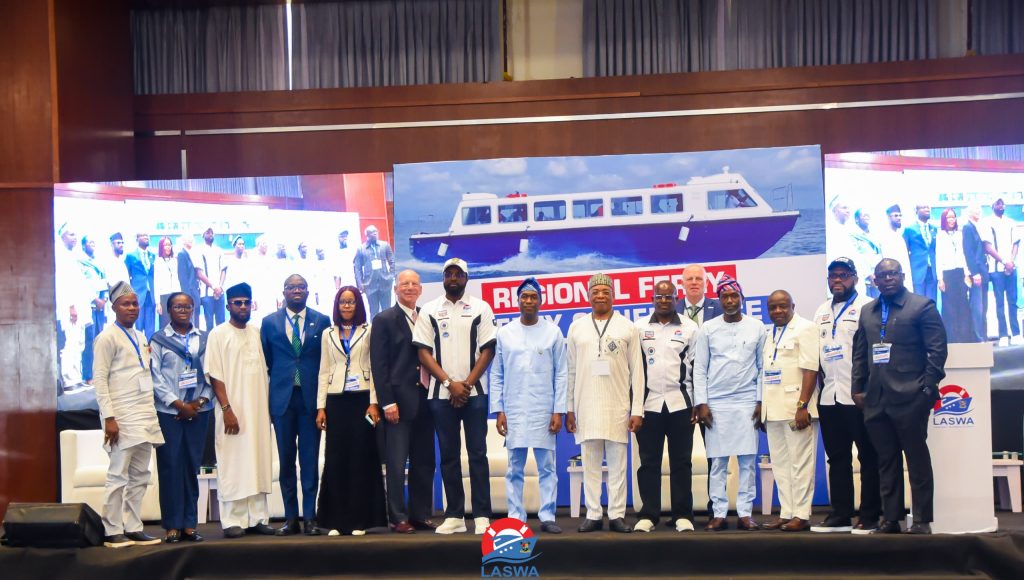
Stakeholders from across the West and Central African brown water economy convened in Lagos on Wednesday for the Regional Ferry Safety Conference, advocating for significant investment and operational reforms in the region’s ferry services.
Key organizations present included the Maritime Organisation for West and Central Africa (MOWCA), Interferry Association, Nigeria’s National Inland Waterways Authority (NIWA), and the Lagos State Waterways Authority (LASWA), which hosted the event.
Speaking at the event, Lagos State Governor, Mr. Babajide Sanwo-Olu, highlighted Lagos’s substantial commitment to ensuring safe and efficient waterways.

Represented by the Deputy Governor Hamzat Oriyomi, Sanwo-Olu said,
“Lagos has made substantial investments in modern jetties, ferry terminals, cutting-edge digital monitoring systems, and comprehensive capacity building initiatives—all aimed at safeguarding our citizens.”
He detailed the deployment of patrol and rescue boats, state-of-the-art safety gear, and the establishment of the first-ever Inland Waterways Monitoring and Data Management Centre through LASWA.
The Governor also noted the implementation of stricter operational guidelines and the introduction of locally built “Omi Bus” standard ferries to boost regional capabilities.
Sanwo-Olu emphasized the regional nature of ferry safety, stating, “We, as West and Central African states, must forge common safety frameworks, share crucial data and intelligence, standardize training protocols, and embrace innovative technologies that elevate navigation and emergency response.”
He urged the conference to “catalyze change” through partnerships, policy alignment, and actionable solutions.
In his remarks, Dr. Paul Adalikwu, Secretary General of MOWCA, explained that Lagos was chosen as the host due to its cosmopolitan nature, multimodal transport system, and extensive water coverage, with approximately 60,000 daily commuters using its waterways.
He recounted discussions at the 48th Interferry Conference in Morocco, where the high incidence of ferry accidents in the MOWCA sub-region, particularly in Nigeria, Senegal, and the Democratic Republic of Congo, was a key concern.
“It was graciously agreed to host a conference that focuses on ferry safety operations and picked Lagos State to host the conference because the State had put in place a robust water transport authority, the Lagos State Waterways Authority (LASWA), ” he said.
Also speaking, Tim Mooney, Chairman of Interferry, announced his company’s plans to infuse capital into Nigeria, specifically Lagos, to enhance and transform ferry operations.
NIWA Managing Director, Mr. Bola Oyebamiji, reaffirmed his Authority’s dedication to safer, more efficient, and sustainable transportation across Nigeria’s inland waterways.
He praised the conference organizers—LASWA, MOWCA, and INTERFERRY—for advancing discussions on ferry safety, stressing that innovation, collaboration, and integrated transport solutions are crucial for passenger and crew safety.
Oyebamiji also highlighted NIWA’s ongoing partnerships with stakeholders like LASWA, ATBOWATON, WABOTAN, and the Maritime Workers Union of Nigeria to improve safety standards, emergency response, and sustainable practices.
LASWA General Manager, Damilola Emmanuel, reiterated the importance of cross-border policy harmonization and stronger technical standards to establish ferry transport as a reliable and environmentally sustainable mode of transportation in Africa.
He echoed the Governor’s call for policy alignment, robust technical standards, and innovative safety practices.
“We are here to forge a safer, more resilient future for ferry transport across Africa’s waterways.
“We must harness innovation, real-time data, and advanced vessel technologies to protect lives and position ferry transport as a key driver in Africa’s blue economy, ” he said.
More to read
NRS, Customs, PEBEC assess NSW progress, to engage terminal operators on demurrage waivers
Shippers’ Council achieves full digitization via ECMS- Akutah
60 shipowners jostle for cabotage fund as NIMASA pledges transparent disbursement