



Former Director-General of the Nigerian Maritime Administration and Safety Agency (NIMASA), Temisan Omatseye, has clarified that the $350 million Cabotage Vessel Financing Fund (CVFF) was not retained in dollars as widely believed but converted into naira to earn higher interest, leaving its dollar value exposed to exchange rate depreciation.
Omatseye disclosed this at the 2026 Annual Summit of the Shipping Correspondents Association of Nigeria (SCAN), held in Apapa, Lagos, where he explained that the decision to convert the funds into naira was driven by the significantly higher interest rates available in the domestic market at the time compared with dollar deposits internationally.
The summit was themed, “Low-Risk Capital for Indigenous Shipowners: Overcoming Regulatory and Financial Bottlenecks.”

According to the former NIMASA chief, interest rates in Nigeria stood between 23 and 25 per cent at the time, while dollar-denominated investments offered returns of about one to two per cent.
He explained that the strategy was to convert dollar receipts from the CVFF into naira to maximise interest earnings in the domestic financial market.
“Interest rate at that time was quite high, 23 per cent, 24 per cent, 25 per cent. And interest rate in dollars was about one or two per cent. Dollar interest rate is very, very low internationally,” he said.
Omatseye noted that the arrangement involved converting the dollar receipts into naira as they were received, with the proceeds placed in local currency accounts to earn higher interest.
He, however, said the subsequent depreciation of the naira, particularly in 2023, significantly affected the fund’s value when measured in dollars.
He cautioned that the original $350 million valuation could not be assumed to remain unchanged because the funds were held in naira rather than dollars.
“So you cannot be looking at $350 million as of 2019 to be the same $350 million today, because the money is held in naira,” he said.
Omatseye urged stakeholders to distinguish between the fund’s historical dollar valuation and its current value, explaining that the latter would depend on the actual naira balance and the prevailing exchange rate.
“When you guys speak of $350 million, CVFF is not held in dollars. It’s in naira, and at the present exchange rates, keep your realistic eye,” he said.
He added that determining the fund’s current dollar equivalent required converting the available naira balance at the applicable exchange rate.
The former NIMASA director-general also noted that any claims about an increase in the fund’s value should be established through verifiable financial records.
Meanwhile, the Minister of Marine and Blue Economy, Adegboyega Oyetola, has reaffirmed the Federal Government’s commitment to accelerating the disbursement of the CVFF to qualified indigenous shipowners.
Oyetola, represented by the ministry’s Director of Press, Anastasia Ogbonna, said he had directed NIMASA to commence the disbursement process to eligible beneficiaries.
He said the administration of President Bola Tinubu was committed to building a competitive maritime sector that would enable Nigerian entrepreneurs to participate meaningfully in domestic and international shipping.
According to the minister, access to long-term financing at commercially sustainable rates remains a major challenge for indigenous shipowners because vessel acquisition requires substantial capital, while high borrowing costs, collateral requirements and lengthy repayment periods place operators at a disadvantage.
He said the government had taken concrete steps to operationalise the CVFF, established under the Coastal and Inland Shipping (Cabotage) Act of 2003 to support indigenous vessel ownership.
Oyetola disclosed that a dedicated application portal was launched in January 2026 to promote transparency, accessibility and efficiency in the process, while the number of approved Primary Lending Institutions (PLIs) was increased from five to 12.
He added that NIMASA had been directed to work closely with the approved lending institutions to accelerate the assessment of applications and disbursement to qualified beneficiaries.
He, however, stressed that the fund must be administered with transparency, rigorous due diligence and prudent risk management, describing it as a revolving facility whose sustainability depended on responsible borrowing, repayment and accountability.
“Our commitment to the effective implementation of the Cabotage Act remains equally firm. We recognise that protecting the legitimate participation of Nigerians in domestic shipping must go hand in hand with building their financial, technical and operational capacity, ” he said.
Oyetola also urged financial institutions to develop financing products suited to the commercial realities of the maritime industry and called on shipowners to embrace sound corporate governance, proper financial reporting and disciplined repayment practices.
He said reducing investment risks required more than making funds available, stressing the importance of a predictable regulatory environment, credible business plans, transparent financing arrangements, effective insurance and reliable revenue streams.
Beyond the CVFF, the minister said the the government was pursuing broader initiatives to strengthen indigenous participation in shipping, improve maritime safety, develop Nigerian seafarers and expand services supporting vessel ownership and operations.
He also disclosed that the government was exploring a commercially driven national shipping line initiative based on private capital, professional management, strategic partnerships and international expertise.
According to him, the initiative would complement indigenous operators, expand Nigeria’s shipping capacity and operate on a sustainable commercial basis.
Oyetola said the government’s broader objective was to encourage greater Nigerian ownership of vessels capable of serving domestic trade and competing in international shipping, while creating more opportunities for Nigerian seafarers to gain sea-time experience and secure employment.
He called for stronger collaboration among government, shipowners, financiers, regulators and industry professionals to remove regulatory and financial bottlenecks, strengthen indigenous shipping and ensure that Nigerians secure a greater share of opportunities in the maritime economy.
Photo caption:
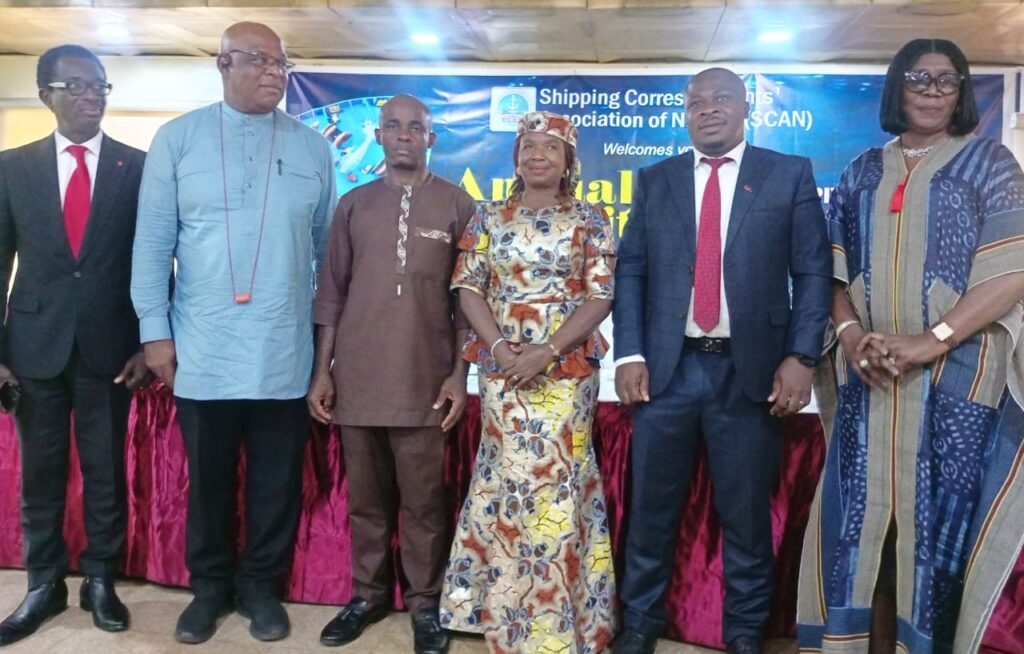
L- R: The Regional Manager, Apapa 2, United Bank for Africa (UBA), Nelson Edoye; Ex-NIMASA DG, Temisan Omatseye; President, Shipping Correspondents Association of Nigeria (SCAN), Moses Ebosele; Representative of the Minister of Marine and Blue Economy, Anastasia Ogbonna; Representative of Dr Olisa Agbakoba, Akunne JohnPaul and the Representative of the DG, Nigerian Ports Economic Regulatory Agency (NPERA), Ify Okolue at 2026 SCAN annual summit held in Apapa on Thursday.
More to read
NPERA to introduce annual Honesty Award for MAN Oron cadets in 2027
Shipowners fault NIMASA, banks over regulatory bottlenecks, high vessel financing costs
Lilypond Customs boosts non-oil exports by 22.14% in Q3