


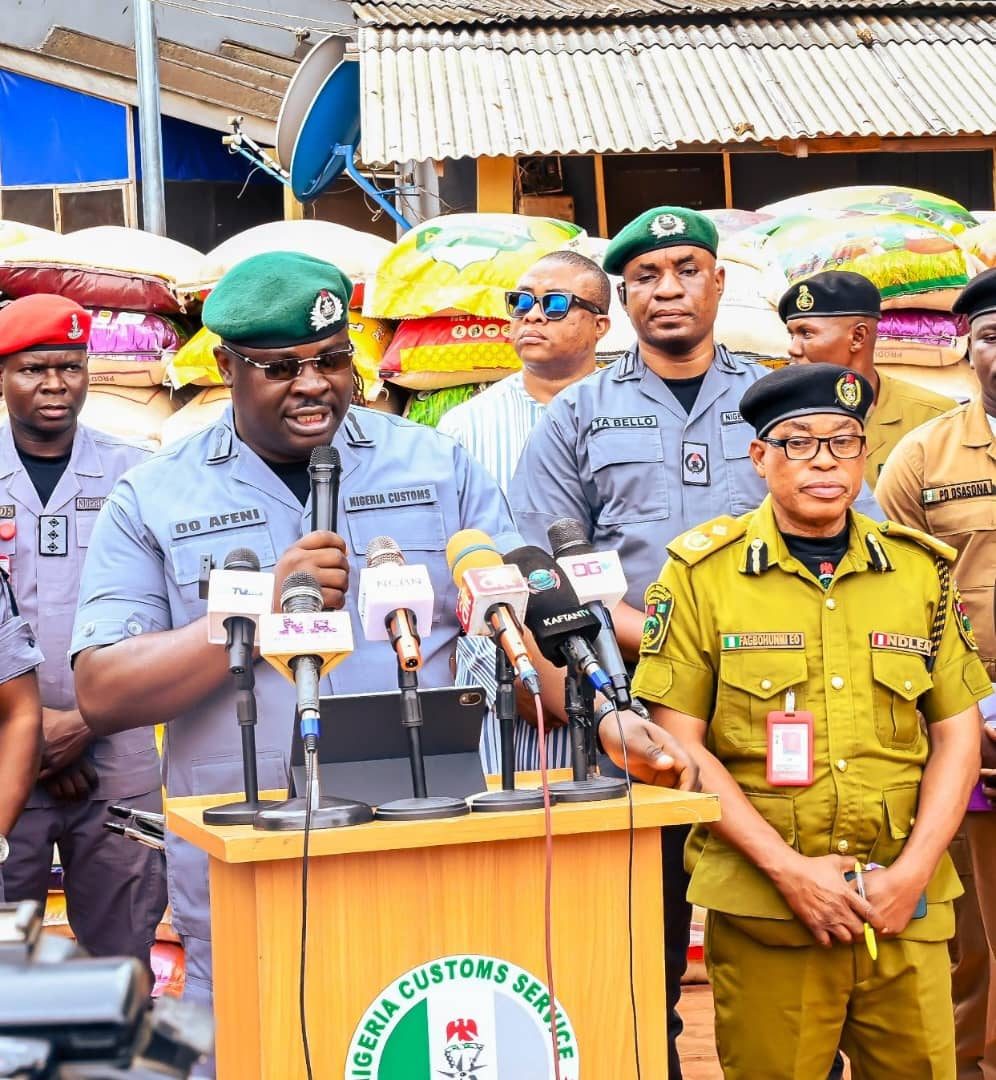

The Nigeria Customs Service, Federal Operations Unit (FOU) Zone ‘A’ under the leadership of Acting Comptroller Oladapo Afeni, has intensified its crackdown on smugglers across the South-West, intercepting N511.4 million worth of illicit drugs and pharmaceutical products and rescuing eight endangered pangolins through intelligence-driven operations and stronger security collaboration.
The fight against smuggling across Nigeria’s South-West has gained fresh momentum under Deputy Comptroller Afeni, with intelligence-driven interceptions targeting illicit drugs, unapproved pharmaceutical products, endangered wildlife, smuggled foreign parboiled rice, frozen chicken and other prohibited items.
Within weeks of assuming leadership of the unit from Idiroko commmad, Afeni has placed renewed emphasis on intelligence gathering, strategic patrols and collaboration with sister security agencies to disrupt smuggling networks operating along major highways, border corridors and waterways in the region.

Recent operations have resulted in the interception of illicit drugs and pharmaceutical products with a Duty Paid Value (DPV) of N511.4 million, as well as the rescue of eight live pangolins in two separate operations in Ogun State, underscoring the unit’s expanding enforcement drive against economic sabotage and transnational organised crime.
Beyond the monetary value of the seizures, the operations highlight the broader implications of smuggling for public health, national security, environmental protection and government revenue.
For Afeni, who oversees FOU Zone ‘A’, one of the Customs Service’s key enforcement formations, the challenge is not merely to intercept prohibited goods but also to make the region increasingly difficult for criminal networks to exploit.
N511.4m Drugs Interception
One of the most significant recent operations under Afeni’s leadership was the interception of assorted illicit drugs and pharmaceutical products subsequently handed over to the National Drug Law Enforcement Agency (NDLEA) and the National Agency for Food and Drug Administration and Control (NAFDAC) for further investigation and legal action.
The seized items, valued at N511.4 million, included 121 parcels of cannabis sativa weighing 65.9 kilogrammes, 100 grammes of crystal methamphetamine, 400 grammes of cocaine, 900 grammes of ground synthetic cannabis, 4.3 kilogrammes of hybrid cannabis and 57 cartons of codeine syrup.
The Customs Service also handed over 86 packs of polythene bags used to conceal the illicit drugs, two vehicles, a Toyota Hiace bus and a Toyota Sienna, and two male suspects linked to separate interceptions.
The operation demonstrated the enforcement unit’s focus on the movement of prohibited substances through major transport routes, where smugglers often attempt to conceal their consignments among ordinary commercial traffic.
According to the unit, one interception occurred at about 1pm on October 10, 2026, when an intelligence-led patrol team stopped a Toyota Hiace bus conveying suspected illicit drugs concealed in polythene bags along the Lagos- Benin Expressway around Ore, Ondo State.
Subsequent examination and analysis by NDLEA officials confirmed the nature of the substances.
In another operation on October 7, Customs officers intercepted a vehicle along the Lagos-Ibadan Expressway. A search revealed 57 cartons of assorted brands of codeine syrup.
The seizures illustrate the variety of smuggling activities confronting enforcement officers, from trafficking in narcotics to the movement of controlled pharmaceutical products capable of entering the market outside established regulatory channels.
Representing Afeni during the handover, the Deputy Comptroller in charge of Enforcement, Oluwaseun Oguntuase, attributed the interceptions to sustained intelligence-driven operations across the unit’s area of responsibility.
He said the seizures and subsequent transfer of the exhibits to the relevant agencies reflected Customs’ determination to protect the nation’s borders, safeguard public health and support national security.
The collaboration with the National Drugs Law Enforcement Agency (NDLEA) and National Agency for Food Drugs Administration and Control (NAFDAC) also ensures that suspected narcotics and regulated pharmaceutical products are handled by agencies with the appropriate statutory responsibilities for investigation, regulatory enforcement and prosecution.
Pangolin Seizures Expose Wildlife Trafficking Networks
Afeni’s enforcement campaign has extended beyond conventional smuggling activities to the illegal trade in endangered wildlife, with two separate operations resulting in the rescue of eight live pangolins in Ogun State within approximately 11 days.
On October 12, 2026, Customs officers intercepted three live pangolins during an anti-smuggling operation along Oyo Dam at Igbo-Ora in Ogun State.
Acting on credible intelligence, the patrol team discovered the animals inside a sack and concealed in a wire-mesh cage. The suspected traffickers abandoned the consignment and fled into a surrounding swamp upon sighting the officers.
The interception was followed by another operation in the early hours of October 23 along the Igbo-Ora/Imeko-Afon axis of Ogun State, where officers intercepted five additional live pangolins confined in wire-mesh cages.
The animals were allegedly concealed in a manner intended to evade detection. The suspects again escaped, abandoning the consignment as Customs officers moved in.
Both operations point to the persistent threat posed by illegal wildlife trafficking and the possibility that organised networks are using less conspicuous routes to move protected species.
Pangolins are among the most trafficked mammals in the world, prized by illegal traders for their scales and meat. Their international commercial trade is prohibited under the Convention on International Trade in Endangered Species of Wild Fauna and Flora (CITES), with pangolins listed under Appendix I.
Nigeria’s laws also provide protection against the illegal hunting, capture and trade of endangered species.
The eight rescued animals were handed over to the Greenfingers Wildlife Initiative Centre for safekeeping, rehabilitation and appropriate management, with the aim of eventual release into a protected habitat where feasible.
The repeated interceptions have raised questions about the networks behind the attempted movement of the animals and the routes used to transport them.
During the second handover, Oguntuase, speaking on Afeni’s behalf, said the interception of separate wildlife consignments within a short period called for extensive investigations to identify and dismantle the syndicates responsible.
He also reaffirmed the unit’s commitment to intelligence-led operations, collaboration with conservation agencies and the enforcement of applicable laws against wildlife trafficking.
The challenge for the Customs Service will be to move beyond intercepting individual consignments to identifying the financiers, transporters, middlemen and intended recipients who sustain the illegal trade.
Security Collaboration At The Heart Of Enforcement
Recognising that smugglers and other criminal networks can exploit gaps between security agencies, Afeni has also moved to strengthen institutional cooperation across the South-West.
On October 14, 2026, he commenced a familiarisation tour of sister security and law enforcement agencies in Lagos, meeting their leadership to explore practical areas of cooperation in intelligence sharing, information exchange, joint operations and law enforcement.
The agencies visited included the Lagos State Police Command, Department of State Services (DSS), Headquarters of the Nigerian Army’s 81 Division, the NDLEA Lagos State Strategic Command, the Nigeria Immigration Service and the Army’s 9 Brigade in Ikeja.
The engagements were designed to reinforce existing relationships and establish closer working arrangements for tackling smuggling, trans-border crimes and other threats to national security.
During his visit to the Lagos State Police Command, where he was received by the Commissioner of Police, CP Tijani Fatai, Afeni stressed that Customs’ responsibilities went beyond border protection and required strong partnerships with other security institutions.
He warned that the approach of an election period could create opportunities for criminal elements seeking to exploit heightened political activity to perpetrate illicit activities capable of triggering crises.
“We know that crime rates often increase as the country approaches the election period, as some people may attempt to take advantage of the period to perpetrate illicit activities capable of causing crises during the elections. Therefore, we are here to call for closer synergy so that these bad elements do not have their way,” he said.
Afeni maintained that no security agency could effectively address complex criminal activities in isolation, stressing the importance of sustained cooperation among institutions with complementary mandates.
The Lagos police commissioner welcomed the engagement, describing the relationship between the police and other security agencies in the state as strong and productive despite Lagos’s large population and complex security environment.
At the Nigerian Army’s 81 Division headquarters, the General Officer Commanding, Major General Adebayo Abdulrahman Babalola, also underscored the importance of joint action against criminality and cautioned against unnecessary administrative bottlenecks that could undermine operational effectiveness.
Such collaboration is particularly important in the fight against smuggling because criminal networks often operate across different jurisdictions, using highways, waterways, border communities and distribution centres to move prohibited goods.
Timely intelligence exchange and coordinated enforcement can help security agencies identify suspicious movements earlier, respond more quickly to emerging threats and prevent offenders from exploiting institutional gaps.
Protecting Revenue, Public Health And Legitimate Trade
The enforcement drive also carries significant economic implications. Smuggling undermines legitimate businesses by exposing compliant importers and traders to unfair competition from operators who evade applicable duties, restrictions and regulatory requirements.
The circulation of illicit drugs and unapproved pharmaceutical products poses additional risks to public health, while the illegal wildlife trade threatens biodiversity and Nigeria’s compliance with international conservation commitments.
For Customs, therefore, effective enforcement must balance the suppression of prohibited trade with the facilitation of legitimate commercial activities.
The seizures under Afeni’s leadership illustrate the range of interests at stake. While the N511.4 million valuation of the seized drugs and pharmaceutical products provides an indication of their declared enforcement value, the broader economic impact includes the potential harm avoided by preventing illicit substances from entering circulation.
Similarly, the rescue of eight pangolins represents more than the recovery of wildlife from traffickers. It demonstrates the intersection between Customs enforcement, environmental protection and the fight against transnational organised crime.
However, the long-term effectiveness of the campaign will depend on whether the interceptions lead to successful investigations, prosecutions and the dismantling of the networks responsible for moving prohibited goods.
The escape of suspects during both pangolin operations highlights a continuing operational challenge: although intelligence and patrols can disrupt consignments, identifying and apprehending the individuals behind them remains critical to achieving lasting results.
Sustaining The Momentum
Afeni has warned smugglers and their collaborators that FOU Zone ‘A’ will sustain its patrols, intelligence-driven operations and cooperation with relevant agencies across its area of responsibility.
The Acting Comptroller’s approach reflects a strategy built around three principal enforcement priorities: improving intelligence gathering, strengthening inter-agency coordination and maintaining operational pressure on routes used for illicit trade.
The repeated pangolin interceptions, coupled with the drug and pharmaceutical seizures, suggest that enforcement efforts are being applied across different categories of prohibited goods rather than being confined to a single smuggling activity.
Yet, sustaining the momentum will require adequate operational resources, reliable intelligence, effective case preparation and closer engagement with communities along vulnerable corridors. These measures can help officers identify suspicious movements, protect informants and improve the chances of apprehending suspects before consignments are abandoned.
There is also a need for continued cooperation with regulatory agencies, conservation organisations and other stakeholders to ensure that seized products are properly investigated, illicit pharmaceutical supplies are traced and rescued wildlife receives appropriate care.
As the Customs Service continues to pursue its mandate, the results of Afeni’s operations will ultimately be measured not only by the quantity and value of goods intercepted but also by the extent to which smuggling networks are dismantled, public health is protected, biodiversity is preserved and legitimate trade is allowed to thrive.
Conclusion
For smugglers operating across the South-West, the message from FOU Zone ‘A’ is clear: intelligence-led patrols and stronger security partnerships are being deployed to make the movement of prohibited goods increasingly difficult.
More to read
COWA sensitizes Apapa market women on breast cancer, donates relief items
Asu Beks honoured as African Maritime Journalism Icon
Customs, TMPL test newly acquired cargo scanners in China ahead of deployment