


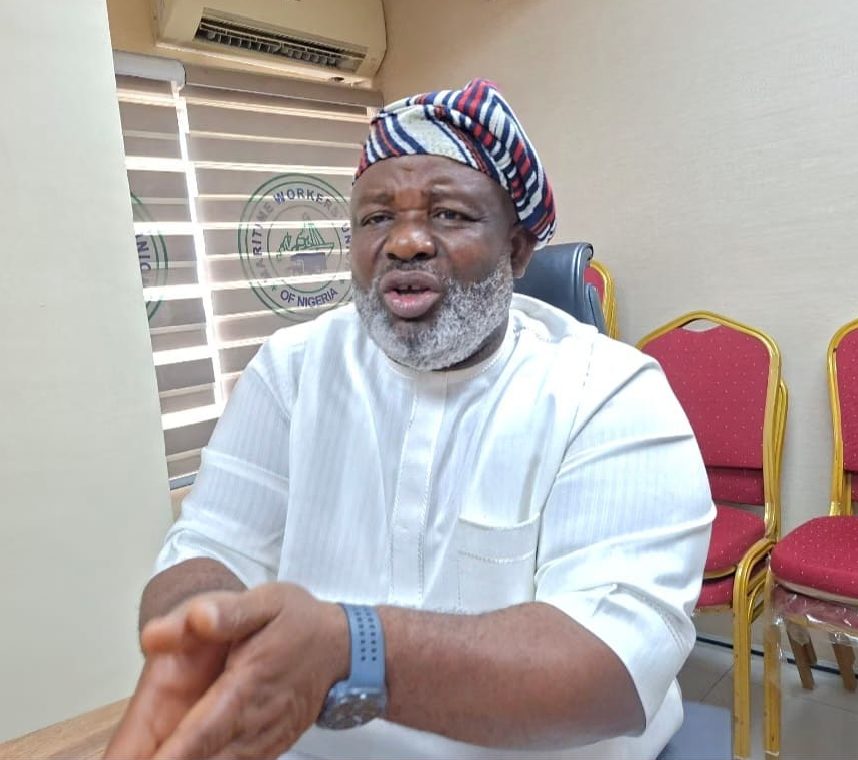

The Maritime Workers Union of Nigeria (MWUN) says it is pushing for global wage standards for Nigerian maritime workers while pursuing plans to diversify its investments to strengthen the Union’s financial base and improve members’ welfare.
The President-General of MWUN, Comrade Francis Bunu, disclosed this in an interview with select journalists shortly after the Union’s National Executive Council (NEC) meeting on Thursday, where he said his administration was committed to securing better remuneration for seafarers, dockworkers and other maritime workers.
Bunu, who described the Union’s investment plans as being at an advanced stage, said the move would open new opportunities for the Union and its members. He also highlighted the Union’s achievements in Collective Bargaining Agreement (CBA) negotiations, insisting that Nigerian maritime workers deserve wages comparable to those of their counterparts in other countries.
He further spoke on the proposed modernisation of Lagos ports, workers’ welfare and the need for companies to recognise the contributions of employees to the growth of the maritime industry.
Read the full interview below.
Excerpts:
You have just concluded your National Executive Council (NEC) meeting. What were the major issues discussed, and what resolutions did the Council reach?
The meeting was an opportunity for us to sit together as a family, examine ourselves honestly and discuss the way forward for the Union.
We believe it is time to face reality, confront our challenges and stop doing things the same way while expecting different result.
One of the major issues we discussed was the need for the Union to diversify its investments and venture into other businesses. We want to build a stronger financial base that will enable us to provide more opportunities for our members and ensure that those who own the Union benefit more from it.
We want our members to be able to look at the Union with pride and say that, indeed, they own an organisation that is making progress and delivering value to them.
The meeting was essentially an internal engagement to set our agenda and determine the direction we want to take as a Union.
We know that these are difficult times for Nigerians, and the Union is equally affected by the economic challenges. Therefore, we need to learn to manage our resources, take difficult decisions where necessary and put our house in order.
Recently, MWUN and the Senior Staff Association issued a 14-day ultimatum to the Federal Government over deductions from NPA’s revenue. What exactly are the concerns of the unions, and what do you expect the government to do?
What we are saying is that workers are working like elephants but eating like ants.
What is left for the people doing this job after the deductions? The situation can be likened to the phrase ‘Monkey dey work, bamboon dey chop? Our bills are not being paid, and they owing workers a lot of money. Whenever they ask for their entitlements, they are told there is no money that the Federal Government has taken 50 per cent.
You send me to do a job, but my welfare is not properly taken care of.
What the Union is asking is that before any deductions are made, the government must ensure that the equipment used to generate the revenue is properly maintained. In this case, the human beings doing the work are also part of that equipment. Why should their welfare not be taken care of? We are suffering. Even before the end of the year, the NPA had already surpassed its revenue target, yet the same workers generating the revenue are suffering. Their allowances and other entitlements are not being paid. Travel allowances, training allowances and other benefits remain unpaid.
What do they expect us to do? We are the ones doing the job.
Has there been any intervention by the government since the unions issued the ultimatum?
Yes, those in authority have been calling, but we know there are people who have the responsibility to address this matter.
However, if they take the Union for granted, then they should be prepared for the consequences because this is about the welfare of workers.
The workers will definitely withdraw their services across the country if the matter is not addressed.
The Federal Government has announced plans to commence the modernisation of the Lagos ports in Apapa and Tin Can Island, with a groundbreaking ceremony. What is the Union’s position on this development?
See, any time you wake up, it is your morning. There is nothing wrong with the government announcing a groundbreaking ceremony. However, once the ceremony is conducted, the next thing we expect is action.
I do not want to pre-empt the government, especially as it has given us a date to commence the project. We are going to give it some time and see what it can achieve.
Some have suggested that the announcement of the groundbreaking ceremony, coming so close to the elections, may be politically motivated. Do you share that concern?
I do not think it is a political tool. Even if it is, there is a limit to which politics can be played with certain issues.
Whether we like it or not, elections will come and go, but this project must stand the test of time. The Union is watching to see whether the project will actually commence.
That is why I said we do not want to pre-empt the government. Let it do what it has promised. We will give it all the necessary support and pray that the reforms we desire at our ports will take place so that workers can have a decent working environment.
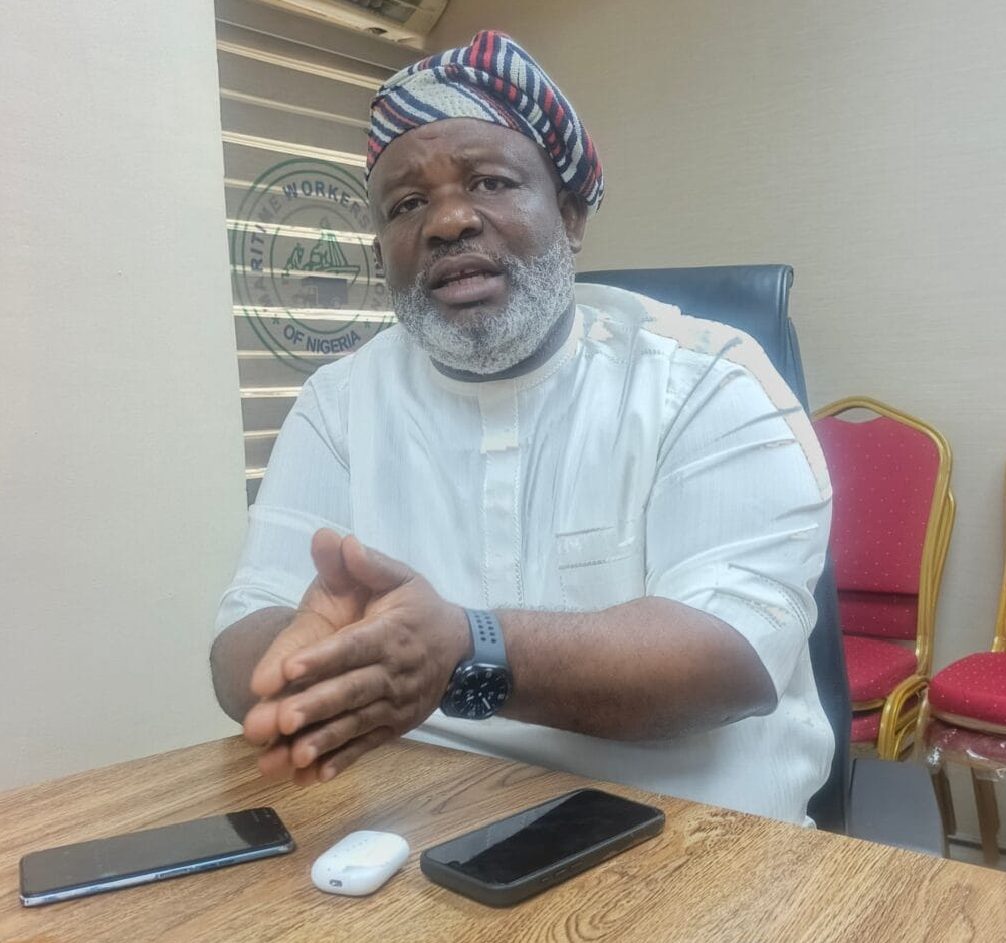
The Union under your leadership has recorded significant achievement in Collective Bargaining Agreements ( CBA) signed with employers of labour to improve workers’ welfare. Beyond the CBAs, what other initiatives are you pursuing, particularly in terms of diversifying the Union’s investments?
Yes, we do not want to blow our own trumpet. But the truth is that we are diversifying.
At the moment, I can say that the Union is pregnant and ready to give birth. It is still too early to disclose what we are working on, but be rest assured that we will not continue doing things the same way and expect different results.
We have told you that we want to venture into investments. That alone will become evident very soon. You will begin to see the things we are doing, and we will be able to take it from there.
For now, however, we want to keep everything low-key.
When it comes to CBA negotiations, this Union can beat its chest and say that we are number one in the country.
We are number one when it comes to negotiating better remuneration for seafarers, dockworkers and other maritime workers. We are among the best in the industry, and we are doing very well.
We ensure that workers receive what is due to them. We want workers to earn wages that can take them from one bus stop to another, while also allowing them to save something for the rainy day.
CBA negotiations are not something that can be concluded in one day. They are processes.
As we speak, we are in the second phase of the CBA negotiations at Lekki Port. We concluded the first phase some months ago, and we are now negotiating for another category of workers at the port.
We have also just concluded negotiations with APM Terminals and are entering the second phase there.
There are several other companies where we are doing similar things. Because of the way the industry operates, we have two categories of workers: casual workers and permanent staff. So, we negotiate separately for both categories.
But, so far, so good. Every CBA the Union has negotiated has brought smiles to the faces of workers. This is the first time many workers are going home happy with the outcomes of their negotiations.
Before you assumed office, there were concerns that your leadership might be characterised by frequent industrial actions. On the contrary we have not witnessed any strike action with several CBA agreement recorded. How were you able to achieve that?
It is transparency.
You do not need to hide anything. It is like frying groundnuts for a blind man. If you do not blow the whistle, he may think you are eating the groundnuts.
As a Union, we have adopted one of the best approaches to CBA negotiations. Everybody must be involved, right from the unit level to the workers themselves. They must be present so that whatever we are doing, everybody can see it.
If we agree, everybody agrees. If we disagree, everybody knows why. It is simply about transparency.
Secondly, in union leadership, temptations will always come. Management may say, “Let us give you five per cent,” they may even offer 10 per cent. If you are not a trade union leader with the capacity to say no, your members will suffer.
But this Union has reached a stage where we can no longer allow our people to suffer. We do not need anybody to influence us when it comes to CBA negotiations.
We ensure that whatever agreement we reach is one that workers can look at and appreciate. I am telling you that this is the first time in the history of the trade union movement that workers are coming back to their union, saying, “you have done well.”
You have described MWUN’s CBA negotiations as among the best in the industry. Are you also working towards ensuring that Nigerian maritime workers’ remuneration measures up to international standards?
As we speak, some workers in Nigeria, through the negotiations conducted by this Union, are earning more than their foreign counterparts- in NLNG.
The International Transport Workers’ Federation (ITF), the International Labour Organisation (ILO) and other labour organisations sat together and agreed on a three per cent increment for seafarers.
But we in Nigeria, through MWUN, said no. Africa is not the same as Europe.
Their salary structures are already different from ours. Our salaries are low, so even if you give us a two or three per cent increase, it does not make much difference to what a Nigerian seafarer earns.
We made our position clear, and the whole world saw it. That is why today, our workers are earning more than their counterparts in some other countries.
Our next phase is to compare what companies pay workers in Senegal, Ghana and Abidjan with what they pay workers here in Nigeria. If we are doing the same job, we should be paid comparable wages. That is where we are heading.
The truth is that Africans do not fully appreciate the value they bring to businesses.
As far as we are concerned, workers account for about 80 per cent of any business operating in the maritime industry. This is because the peace companies enjoy is provided by the Union.
Just this morning, Thursday, when there were reports that workers wanted to shut down Lekki Port, people were making calls everywhere. But the Union was there to engage and talk to the workers.
Secondly, who generates the money these companies make? It is the workers. We provide both industrial peace and productivity. So, who really owns the business?
It is high time companies recognised that workers account for 80 per cent of their businesses and should be adequately taken care of.
You can travel to China or America to buy equipment without questioning its value. But when you bring that equipment here, you want to pay the people who will operate it a meagre salary.
Without human beings, that equipment cannot function. So, it is time we looked at the value of every worker and insisted that what you pay a worker in China should be comparable to what you pay a worker in Nigeria. That is the direction the Union is moving.
Some terminal operators have yet to secure the renewal of their concession agreements. What is MWUN’s position on the matter?
It is none of our business. If any terminal concession agreement has not been renewed, it is the responsibility of the government to decide what to do.
The government is the one that grants them the concessions, and our responsibility is to do our jobs.
We will not take it upon ourselves to campaign for any terminal operator or lobby the government to renew its concession agreement. That is not our responsibility.
The Union’s business is to protect and promote the welfare of workers employed by companies that have dealings with the government.
But the Union has Collective Bargaining Agreements with some of these terminal operators. Doesn’t that give you a stake in their continued operations and concession renewals?
Our CBA agreement is with the workers. It is about the workers.
It is high time the Union confined itself to the responsibilities for which it was elected. Otherwise, we may end up chasing shadows instead of addressing issues that directly affect workers.
If Company A is assigned to operate, I will work with it. If Company B comes, I will also work with it. The same applies to Company C.
I cannot take sides with one company against another. That is not the responsibility of the Union.
In the past, however, things happened differently. People would come to the Union and say, “Fight for us.” We are not supposed to allow emotions to determine our position.
More to read
Customs suspends training activities over FCC recruitment concerns
NIWA clears water hyacinth on Jabi Lake, moves to sustain tourism activities
Tincan Customs boss raises concern over absenteeism of releasing officers