


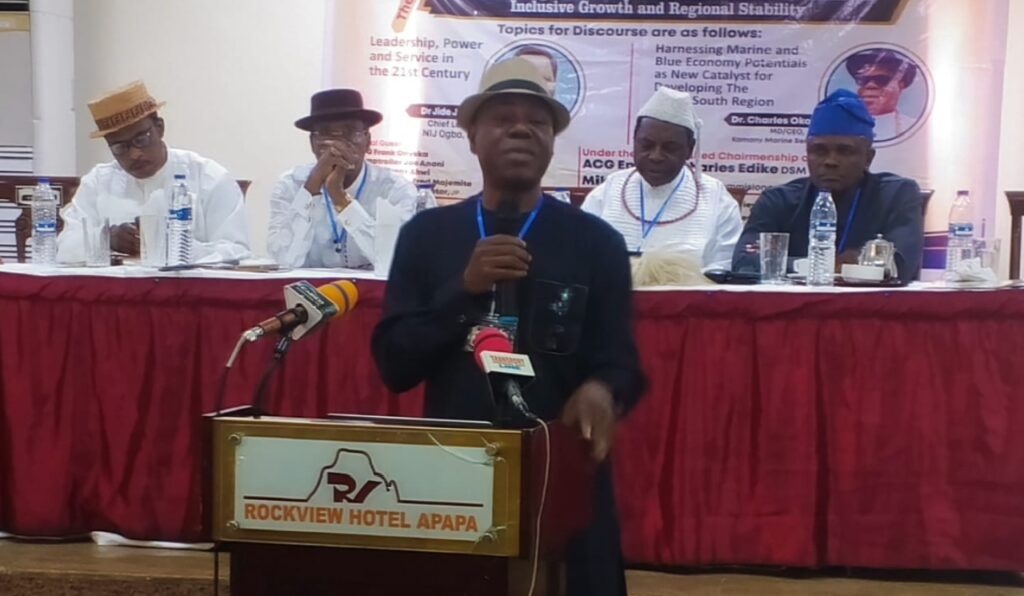

Maritime industry stakeholders have urged South-South governors to collaborate in developing dedicated fish ports across the Niger Delta as part of efforts to harness the region’s vast marine and blue economy potential.
Maritime expert and Managing Director of Kamany Marine Services Limited, Dr. Charles Okorefe, made the call while delivering a paper titled, “Harnessing Marine and Blue Economy Potentials as a New Catalyst for Developing the South-South Region,” at the 20th anniversary celebration of The South-South International ( TSSI) Magazine held in Lagos on Wednesday.
The former lecturer at the Nigerian Maritime University (NMU), Okerenkoko, Delta State, said the region was endowed with enormous marine resources that could generate employment, strengthen food security and improve its economic fortunes if properly harnessed.

He identified fisheries, aquaculture, marine biotechnology, renewable marine energy, coastal tourism, shipbuilding and repair, dredging, marine support services and inland waterways transportation as key areas with significant economic opportunities.
Okorefe lamented that Nigeria produces only about 1.2 million metric tonnes of fish annually, representing 40 per cent of the country’s fish consumption, while the shortfall is met through imports.
According to him, the South-South region has abundant water resources capable of supporting commercial fishing and fish exports, but the opportunities remain largely untapped.
He therefore urged governors in the region to work together to establish dedicated fish ports and develop regional aquaculture clusters to strengthen the fisheries sector.
Okorefe also advocated increased investment in aquaculture, citing Bayelsa State’s recent revival of an abandoned fish farming project as an example for other Niger Delta states to emulate.
He said aquaculture would provide a reliable source of food, reduce pressure on wild fish populations and promote rural development through infrastructure investment, cold chain technology and job creation.
On marine biotechnology, Okorefe said the region could exploit resources in its oceans, rivers and other water bodies for the production of medicines, cosmetics and food products.
He noted that countries such as India had invested significantly in research and development to harness marine resources for economic benefits, urging Nigeria to follow a similar path.
The maritime expert also called for investments in renewable marine energy, including offshore wind and tidal power, saying the region’s extensive coastline and water resources offered opportunities to generate sustainable electricity.
According to him, such investments could reduce greenhouse gas emissions, power coastal industries and provide electricity to riverine communities.
”I don’t understand why the states in the Niger Delta cannot generate energy for themselves using renewable energy, using the resources of the oceans, whereas we are surrounded by water. If you go to the Netherlands, for instance, they use wind power to generate electricity. We’ll be shouting ‘UP NEPA’ when they bring light when we are supposed to be having constant light generated from our own water bodies.
”Until today, we are still buying generators for government houses across our states. It’s an anomaly, “he lamented.
He further identified coastal tourism as another area capable of boosting the region’s economy, citing the Ethiope River in Delta State as a natural attraction with significant ecotourism potential that remains underdeveloped.
Also speaking at the event, Dr. Jide Johnson of the Nigerian Institute of Journalism highlighted the critical role of leadership and media accountability in driving regional transformation.
Johnson expressed concern over what he described as the declining vibrancy of the Lagos press, recalling its prominent role during the colonial, pre-independence and post-independence eras.
He questioned why the press, which was once vibrant and influential, had become less active, urging journalists to reclaim their responsibility of holding public officials accountable under democratic governance.
He also called on journalists to uphold professional standards and ensure objective reporting of the 2027 general elections.
Earlier, in his welcome remarks, the Publisher of The South-South International Magazine, Dr. Ovie Edomi, expressed gratitude to stakeholders for their unwavering support over the past two decades.
Edomi assured guests that as the publication enters its third decade, it would continue to grow stronger and remain committed to developmental journalism.
He pledged that the magazine would sustain its role as a credible and incisive platform for agenda-setting discourse, holding leaders accountable and highlighting viable economic opportunities capable of driving sustainable growth across the South-South states.
More to read
NIWA clears water hyacinth on Jabi Lake, moves to sustain tourism activities
Tincan Customs boss raises concern over absenteeism of releasing officers
Nigeria, Russia strengthen Customs cooperation to optimise trade facilitation, information exchange