



The Nigeria Customs Service (NCS) has attributed its consistent growth in revenue generation to sustained reforms, modernization initiatives, increased cargo throughput, and improved stakeholder compliance rather than the devaluation of the naira.
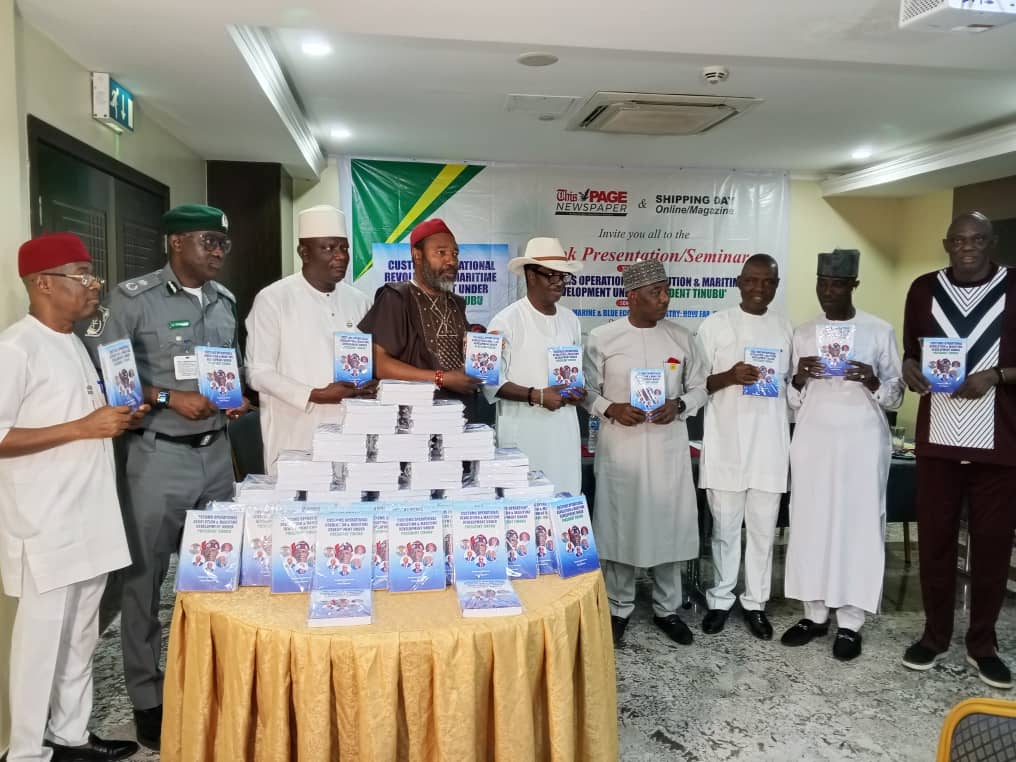
Deputy Comptroller General of Customs, Strategic Research & Policy Dera Nnadi,( RTD) stated this at the launch of the book “Customs Operational Revolution and Maritime Development Under President Bola Ahmed Tinubu,” authored by veteran journalists Chief Timothy Okorocha and Francis Ugwoke.
Speaking on Customs revenue performance, Nnadi dismissed claims that the Service’s rising revenue profile was primarily driven by fluctuations in the exchange rate.

According to him, the historical trajectory of Customs revenue demonstrates that collections have consistently increased alongside major reforms and modernization efforts within the Service.
“To answer the question about whether the devaluation of the naira influenced increased Customs revenue, I want to refer us to the historical evolution of Customs. The first time Customs collected N3trillion, it was celebrated. Subsequently, Customs generated over N5 trillion, and then achieved the landmark N7 trillion revenue collection in 2025.
“So it means that when Customs collected the first trillion, aira was not devalued then. So there’s consistent record that customs revenue keeps increasing as the reforms in customs take place.”
Nnadi noted that revenue growth had been recorded long before the recent exchange rate adjustments, stressing that each phase of Customs modernization had produced corresponding increases in revenue performance.
“When Customs operated under ASYCUDA, we moved from the basic version to ASYCUDA 2.0 and recorded our first trillion naira. We later transitioned to NICIS and generated over N5 trillion. With the adoption of the B’Odogwu platform, revenue rose to N7 trillion. This clearly shows that reforms and modernization improve revenue generation,” he added.
He further explained that increased cargo throughput, population growth, and expanding trade activities had also contributed significantly to Customs revenue.
According to him, imports should not be viewed solely as finished products, as raw materials and export activities equally contribute to revenue generation and economic growth.
Nnadi also credited robust stakeholder engagement and increased voluntary compliance for the impressive revenue performance recorded by the Service.
He recalled that despite the volatility experienced during the exchange rate reforms, when the naira fluctuated more than 36 times within three months Customs successfully managed the challenges and sustained revenue collection.
He assured that with the current stabilization of the exchange rate, “Nigerians should expect more miracles from Customs in revenue generation because several factors contribute to the growth, not just one index,” he said.
Also speaking at the event, the Comptroller-General of Customs, Bashir Adewale Adeniyi, represented by the Customs Area Controller of Murtala Muhammed Airport Command, Comptroller Chidi Nwokorie, said the Service’s improved revenue performance was the result of deliberate reforms and strategic partnerships.
Adeniyi said the establishment of the Federal Ministry of Marine and Blue Economy had provided a platform for unlocking the economic potential of Nigeria’s maritime sector, while Customs had aligned with the administration’s vision through modernization and digital transformation initiatives.
He explained that the deployment of technology had simplified Customs procedures, reduced human contact, enhanced transparency, and facilitated legitimate trade.
According to him, expanded automation, innovative Customs solutions, and stronger stakeholder engagement mechanisms have significantly improved service delivery and aligned Nigeria’s Customs operations with international best practices.
“On customs revenue generation,
It’s no secret, because we are all in it together. We have improved performance through strategic reforms, improved compliance measures, intelligence-driven operations, and enhanced accountability. And with that service has consistently recorded impressive revenue performance, while maintaining its core responsibilities of facilitating trade.
“Technology and automation, increased deployment of digital customs processes, reduction of manual interventions and loopholes, improved monetary transparency and compliance, intelligence-led operations, which is shifting from random enforcement to intelligence-driven targeting, better risk assessment and profiling of high-risk shipments, more effective anti-smuggling operations with fewer resources are some of the factors responsibile for our increased revenue, “he said.
He commended stakeholders for supporting Customs reforms, noting that most of the Service’s policies were indigenous, and developed with stakeholder input.
Reviewing developments in the maritime sector over the past three years, Adeniyi said meaningful progress had been made through improved collaboration among maritime agencies, increased attention to port efficiency, growing interest in blue economy opportunities, and renewed commitment to trade facilitation.
He, however, stressed the need for continued investment in infrastructure, digital transformation, capacity building, and human capital development to fully realize Nigeria’s maritime potential.
The CGC reaffirmed the commitment of the Nigeria Customs Service to supporting government initiatives aimed at promoting trade, enhancing national security, increasing revenue generation, and driving sustainable economic growth.
Describing the book as a timely contribution to national discourse, Adeniyi lauded the efforts of the authors for documenting the reforms, which he said would enable future generations, policymakers, and stakeholders to learn from past experiences and build on existing achievements.
In his welcome address, co-author Chief Timothy Okorocha said, “We observed many important developments that deserved to be preserved beyond newspaper headlines and daily reportage. We felt strongly that there was a compelling need to document these institutional journeys—not merely as events of the moment, but as part of the enduring historical and intellectual record of our nation.”
A highpoint of the event was the official unveiling of the book, which was presented to stakeholders who commended the authors for a job well done.
More to read
Omi Eko: Management clarifies project implementation process
Customs intercepts N3.67bn cannabis-infused cookies, gummies from Canada at Tin Can port
Navy uncovers 40,000 litres of suspected crude oil in Delta