


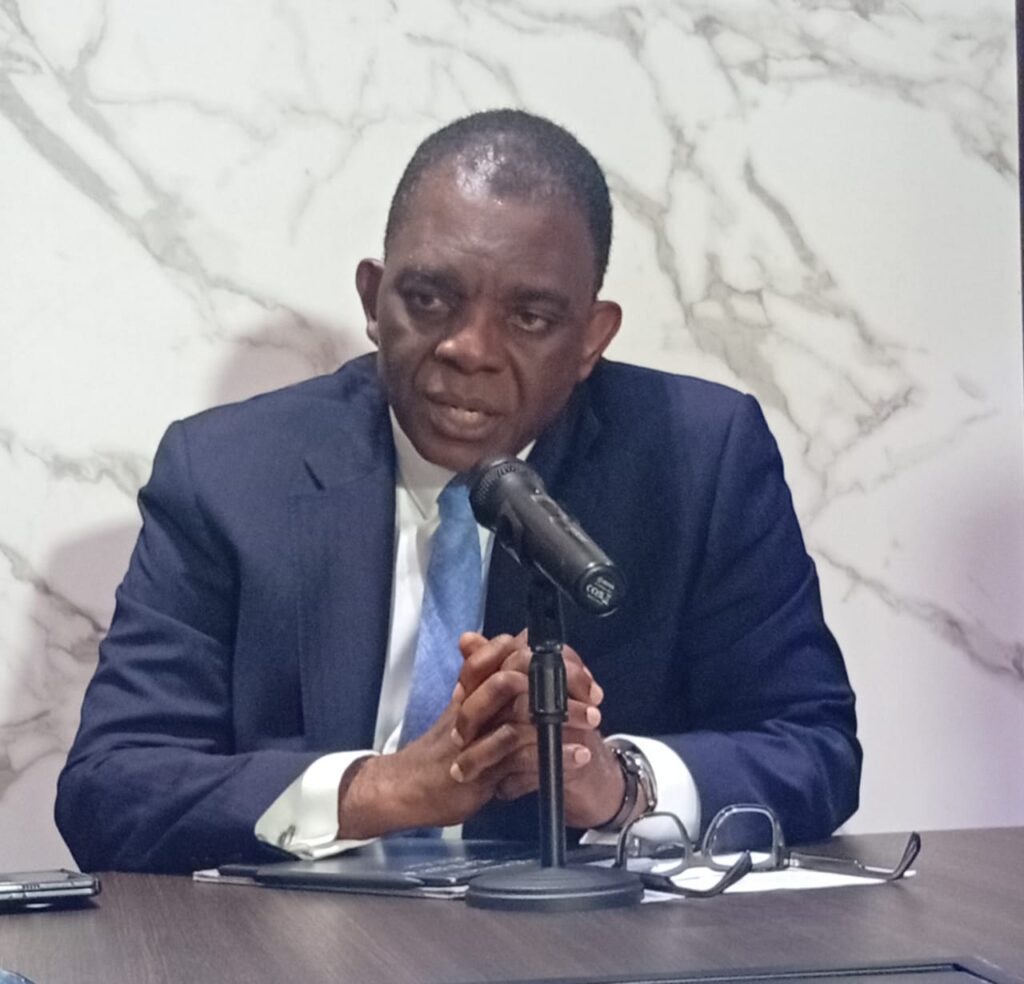

The Nigerian Ports Economic Regulatory Agency (NPERA) has warned that corporations that repeatedly violate port regulations could face penalties of up to N20 million and prosecution, as part of measures to deter infractions and improve efficiency in the nation’s ports.
The Director-General of NPERA, Dr Pius Akutah, disclosed this in Lagos Tuesday, when executive members of the Shipping Correspondents Association of Nigeria (SCAN), led by its President, Moses Ebosele paid a courtesy visit to the agency.
Akutah said the establishment of NPERA was aimed at making Nigeria’s ports more efficient and competitive through stronger enforcement, standard-setting, automation and digitisation.

He explained that the agency now had stronger legal provisions to sanction infractions, unlike the previous regulatory framework under the Nigerian Shippers’ Council, where penalties were insufficient to serve as effective deterrents.
“In the past, there was no such potency in our law, so we couldn’t enforce anything because the penalties were too insignificant to deter any infraction.
“That’s not the case now, as the least penalty in that law is a N500,000 fine for an individual first offender,” he said, adding that the penalty could increase where the offender continued to violate the law.
According to him, the highest penalty for a corporation is N20 million, while the agency has the power to multiply the penalty where a company continues to commit an infraction.
He added that provisions for legal enforcement and criminal prosecution of infractions under the NPERA law would further serve as deterrents.
Akutah, however, stressed that the objective was not to disrupt port operations but to establish a regulatory regime that would encourage stakeholders to comply with standards.
“The idea is not to upset the system and make it chaotic or abnormal but rather to create a deterrent regime through the provisions of the law. With the fear of the consequences, they will play by the rules naturally,” he said.
He said NPERA would focus on setting standards and promoting innovation and digitisation to make compliance easier, while ensuring that established standards were not lowered.
“Ours is to set the standards and promote innovations and digitisation of this sector to the point that those standards become very easy for people to maintain. Enforcement, on our own part, is continuing to ensure that these standards are not lowered at any time,” he stated.
On concerns over multiple regulatory agencies conducting physical checks at the ports and their possible impact on trade facilitation, the NPERA boss said the agency was not seeking to prevent other government agencies from carrying out their statutory responsibilities.
He, however, said such activities must be conducted responsibly and in a manner that did not unnecessarily delay cargo clearance.
Akutah maintained that greater automation and reduced human interference in port processes would help eliminate bottlenecks, make operations more seamless and reduce the cost of doing business.
“Once these processes are seamless, it will reduce costs on its own. The cost component is very crucial to us,” he said.
The NPERA DG linked the agency’s mandate to the Federal Government’s ambition of building a $1 trillion economy by 2030, stressing that the target should not be measured only by government revenue.
“If we are building a trillion-dollar economy, it is not only in terms of the amount of money that government will make but also the totality of the GDP of the economy that will promote that one trillion dollars,” he said.
He added that the focus should also be on the growth of businesses and wider economic activities.
“It is not just about what revenue the government is making but also how much business is booming in the country. Within a limited time, we will begin to see the results,” Akutah stated.
He also dismissed concerns over possible operational conflict between NPERA and the Nigerian Ports Authority (NPA), explaining that the two agencies have distinct responsibilities.
According to him, while NPA is responsible for the development of port infrastructure, including seaports and inland dry ports, NPERA is responsible for the economic regulation of the facilities.
Akutah maintained that agencies within the marine and blue economy sector were working together to support the Federal Government’s economic diversification agenda and the target of building a $1 trillion economy by 2030.
More to read
Omi Eko: Management clarifies project implementation process
Customs intercepts N3.67bn cannabis-infused cookies, gummies from Canada at Tin Can port
Navy uncovers 40,000 litres of suspected crude oil in Delta