


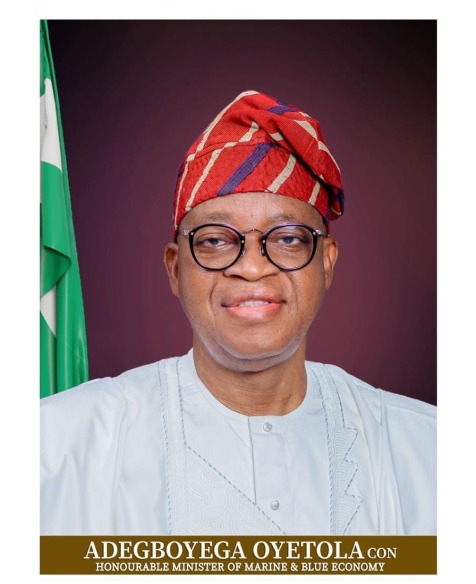

...says Lagos focus not preferential
The Federal Government has expressed it’s committment to developing a balanced, efficient and interconnected national port system in which Lagos and the Eastern ports complement one another, rather than compete for attention and investment, the Minister of Marine and Blue Economy, Adegboyega Oyetola, has said.
Oyetola stated this on Thursday in Lagos at the 2026 Annual General Meeting and Conference of the League of Maritime Editors, with the theme, “Lagos/Eastern Ports: How to Reverse Existing Imbalance in Disproportionate Cargo Vessel Calls.”

Represented by the Ministry’s Director of Press, Mrs Anastasia Ogbonna, Oyetola said the modernisation and rehabilitation of the Eastern ports were integral parts of the Federal Government’s port development strategy, aimed at addressing infrastructure and operational constraints that had historically limited their competitiveness.
According to him, the government’s interventions will include improving channel depths and navigability, rehabilitating critical port infrastructure, enhancing navigational safety, upgrading cargo-handling facilities, strengthening security and improving the operating environment for shipping lines, terminal operators and cargo owners.
Oyetola said the reconstruction of breakwaters and channel-management interventions, including works along the Escravos Channel, as well as new investments by private terminal operators, were important components of the broader port development strategy.
He added that the government was encouraging greater private-sector participation because the scale of investment required in the sector could not and should not be borne by government alone.
“Our objective in this regard is straightforward: to make every viable Nigerian port capable of competing for cargo on the basis of efficiency, reliability, cost and quality of service,” he said.
He noted that while Apapa and Tin Can Island ports had historically handled the bulk of the country’s seaborne cargo, the resulting pressure had contributed to congestion, longer cargo dwell and vessel turnaround times, increased demurrage and logistics costs, pressure on road infrastructure and environmental challenges.
According to him, the Eastern ports, including Onne, Port Harcourt, Warri and Calabar, possess significant potential because of their proximity to industrial, agricultural, energy and commercial activities in the South-East, South-South and North-Central regions.
He, however, identified draft limitations, poor infrastructure, navigational constraints, security concerns, inadequate hinterland connectivity, equipment, operational costs and unpredictability of services as factors limiting the ability of the ports to attract regular and competitive vessel calls.
Oyetola said reversing the imbalance was not a regional demand but a national economic imperative, stressing that the Federal Government was committed to modernising and rehabilitating the Eastern ports.
He explained that the focus on the Western ports, particularly Apapa and Tin Can Island, was not preferential treatment for Lagos but a result of operational urgency, economic necessity, project readiness and responsible sequencing.
“We are not developing Lagos at the expense of the East. We are strengthening Lagos while building the capacity of the Eastern corridor to assume a greater and more strategic share of national maritime traffic,” he said.
The minister said the government’s long-term objective was to create a system where cargo owners and shipping lines could choose ports based on efficiency, cost, reliability and proximity to markets.
He added that infrastructure development alone would not redistribute cargo because shipping lines make commercial decisions based on factors including draft, berth availability, cargo volumes, turnaround time, security, reliability, tariffs and hinterland connectivity.
Oyetola therefore called for operational and commercial incentives, stronger maritime security, digitalisation of port processes, improved road, rail, inland waterway and barge connectivity, as well as greater private-sector participation.
He said the National Single Window, Port Community System and other digital initiatives would help reduce physical interactions, improve transparency and make cargo clearance more predictable.
The minister also urged the maritime media to play a stronger role in promoting accountability and providing evidence-based information on port performance.
In his opening address, the Chairman of the conference and former General Manager, Corporate Affairs, Nigerian Ports Authority ( NPA), Captain Iheanacho Ebubeogu, said the issue of cargo imbalance should be approached from the standpoint of port competitiveness.
Ebubeogu said ports must attract cargo by providing operational efficiency, deep-water access, competitive tariffs, reliable hinterland connections, fast customs clearance, safety, security and regulatory compliance.
He identified captive cargo and contestable cargo, noting that contestable cargo was the major area of concern because it could move between competing ports depending on cost and service quality.
He stressed that the Eastern ports could not become competitive without a strong industrial and cargo-generating base to support them.
Also speaking, the Executive Secretary of the Nigerian Shippers’ Council, now transmuted to Nigerian Ports Economic Regulator Agency ( NPERA) Dr. Pius Akutah argued that equitable cargo distribution should not mean forcing shipping lines or importers to allocate fixed percentages of cargo to particular ports.
Akutah who was represented by the Acting Director, Regulatory Services ,NSC Mrs Adaora Nwonu said cargo should instead flow to ports that offer the best combination of efficiency, cost, connectivity, reliability and service quality.
Akutah called for a transparent and competitive regulatory environment that would prevent discriminatory practices, artificial restrictions and market distortions that favour one port or corridor over another.
He further recommended the development of a National Port Competitiveness Index to regularly publish performance indicators for major ports, including cargo throughput, vessel turnaround time, berth productivity, cargo dwell time, port charges, customs processing time, cargo evacuation capacity, rail and inland-waterway connectivity and customer satisfaction.
Akutah also called for a National Cargo Distribution Strategy based on port specialisation and comparative advantage, stressing that rail, inland waterways and dry ports must be integrated into the national cargo distribution system.
He said strengthening competition among Nigerian ports, improving connectivity and making port data publicly available would enable shippers to make informed decisions and encourage ports to compete on measurable performance.
Earlier, the President of the League of Maritime Editors, Mrs Remi Itie, said the conference was organised as part of the media’s responsibility to set the agenda for policymakers and promote nation-building.
Itie called for strategies to reverse the imbalance in cargo calls between the Western and Eastern ports, noting that while Lagos ports enjoyed comparative advantages, greater cargo distribution to the Eastern corridor would help boost economic activity in the region and increase the country’s economic potential.
She also urged the government to map Nigeria’s coastal areas and develop major seaports around them, while calling for urgent action on pollution and waste along the coastal corridor.
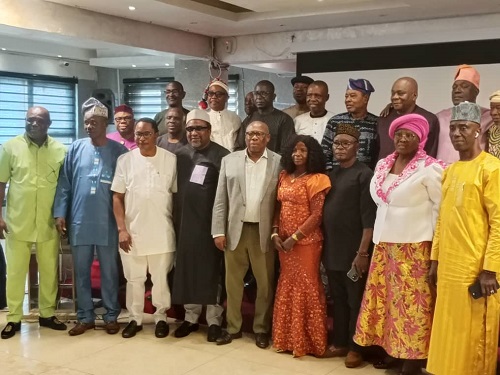
The conference brought together key stakeholders from the maritime sector, including ACG Charles Edike, Rtd, Mr. Lucky Amiwero, the Vice President of the Association of Nigerian Licensed Customs Agents (ANLCA), Prince Segun Oduntan, Dr. Charles Okorefe among others.
More to read
Omi Eko: Management clarifies project implementation process
Customs intercepts N3.67bn cannabis-infused cookies, gummies from Canada at Tin Can port
Navy uncovers 40,000 litres of suspected crude oil in Delta