


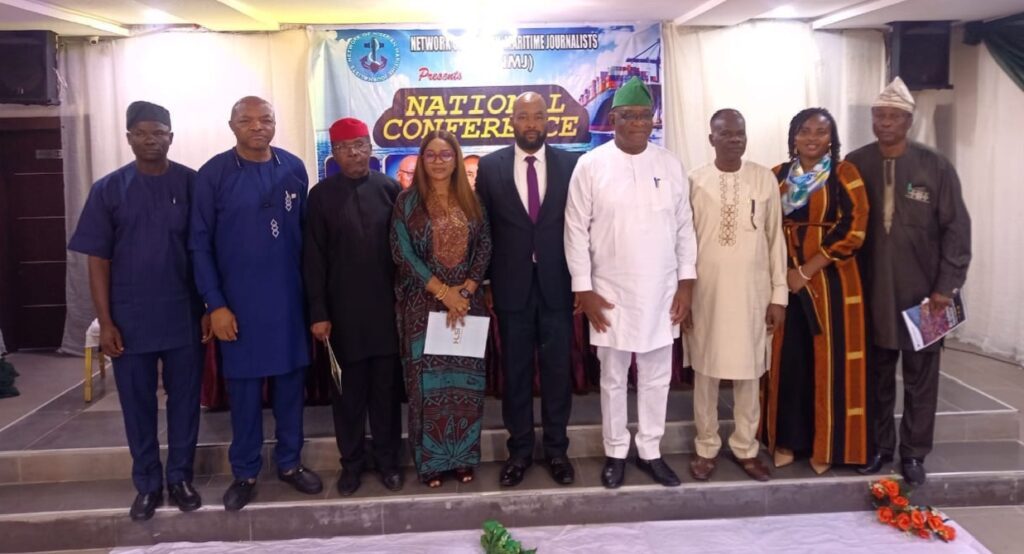

Industry stakeholders have commended maritime journalists for coming together under one professional umbrella, describing the initiative as a milestone capable of strengthening the industry and promoting responsible journalism.
The stakeholders spoke at the National Conference of the Network of Nigerian Maritime Journalists (NNMJ) , where they urged members of the newly established network to uphold professionalism, embrace investigative reporting and provide constructive criticism to drive development in the maritime sector.
Former Director-General of the Nigerian Maritime Administration and Safety Agency (NIMASA), Temisan Omatseye, who chaired the occasion, urged maritime journalists to be more courageous in holding industry players accountable while offering practical solutions to identified challenges.

Omatseye warned that the maritime industry must not be allowed to decline, stressing that Nigeria has the cargo, expertise and resources to build a thriving maritime sector.
”Please, we cannot allow our maritime industry to die. The cargo is there. We own the cargo. We have the cargo. We have the expertise,” he said.
He challenged journalists to make their criticism constructive by not only identifying problems but also suggesting ways of addressing them.
According to him, some maritime journalists have become too comfortable with publishing reports that favour industry stakeholders instead of speaking the truth.
“My problem with some of these journalists is that you guys are too soft. You write what they tell you to write in their favour rather than telling the truth. The truth shall never fail,” he said.
He urged journalists to investigate issues and demand practical solutions from relevant authorities.
He further challenged the network to investigate why neighbouring ports, particularly Lome, continue to attract cargoes that could have been handled in Nigeria, as well as why the country has yet to fully develop its bunkering operations despite its capacity to produce bunker fuel.
“Let us do more investigative journalism. Ask questions. Research. What are the international best practices going on around the world? Why is Lome taking our cargo? Why are we not doing bunkering operations here when we are producing all the bunkers?” he asked.
Also speaking, Chairman, Nigerian Ports Consultative Council ( NPCC) Bolaji Sumola urged the journalists to give greater attention to positive developments in the maritime industry, noting that their responsibility should include showcasing achievements alongside reporting challenges.
In his goodwill message, the Director-General of NIMASA, Dr Dayo Mobereola, commended the initiative to unite maritime journalists under one professional platform.
Mobereola, who was represented by the Assistant Director, Public Relations, Oby Chuma-Ugbo, described the development as an important step towards strengthening professional collaboration, promoting responsible maritime journalism and creating a coordinated platform for engagement with industry stakeholders.
He expressed confidence that the network would enhance the credibility, visibility and international recognition of maritime journalism in Nigeria.
The NIMASA boss also appreciated journalists for their consistent support in projecting the agency’s activities and achievements, describing the media as an indispensable partner in promoting public understanding and accountability in the maritime sector.
”Through your reporting, analysis and dissemination of information, you help citizens form an understanding of the maritime industry, promote accountability and ensure that developments within the sector receive the attention they deserve,” he said.
He reaffirmed the agency’s commitment to strengthening its relationship with the media through timely access to credible information, regular engagement and constructive feedback to improve its performance and service delivery.
Similarly, Assistant Comptroller-General of Customs,Charles Edike, (RTD) commended the network, recalling that during his years of service at the Lagos ports, he did not experience blackmail from maritime journalists.
Edike urged members to preserve the integrity and professional standards associated with responsible journalism, warning against practices capable of damaging the reputation of the profession.
He also challenged the network to look beyond organising conferences and focus on implementing the ideas and resolutions generated at such gatherings.
“For me, the most important thing is after the conference, what do we do? What do we do with what we get in the conference? Do we harness it? Do we use it?” he asked.
More to read
Tinubu: Bakassi deep seaport a game- changer for Nigeria’s blue economy
Nigerian seaports lack capacity to support $1tr economy by 2030 – Akabogu
NIWA, Bangladesh explore bilateral partnership to boost inland water transportation